Small businesses have a collaboration problem that enterprise software vendors don't want to acknowledge: the tools built for large organizations are almost always overkill, and the tools built for individuals are almost always underpowered. You end up paying for features you'll never use, or working around limitations that make the product feel like a workaround itself.
The good news is that the collaboration tools market has matured enough that genuinely great options exist for teams of 5 to 50 people-tools designed for your scale, your budget, and the reality that you don't have a dedicated IT team to manage complex integrations or run change management programs for every software rollout.
This article is specifically for that range. Not solopreneurs, not enterprises. The messy, fast-moving, resource - constrained small business that needs to collaborate well without turning software selection into a second job.
Why Small Businesses Have Unique Collaboration Needs
The collaboration challenges at a 15-person company are structurally different from those at a 500-person company, and not just in scale. Small businesses typically share a few common traits that shape what collaboration tooling actually helps.
First, everyone wears multiple hats. The person running your paid acquisition might also be coordinating the content calendar, onboarding a new contractor, and answering customer support tickets. Collaboration tools for small businesses need to support generalists doing varied work, not specialists with deep workflows in a single function.
Second, budget matters in a way it simply doesn't at enterprise scale. A $50/user/month tool might be trivially affordable for a 1,000-person company and genuinely difficult to justify for a 15-person startup watching burn rate. The ROI calculation is more direct and more urgent.
Third, adoption is everything. At a large company, you can mandate tool adoption through policy, training programs, and management enforcement. At a small business, if the tool is annoying or confusing, people will simply revert to email and WhatsApp within two weeks, and you've wasted both the money and the momentum.
Fourth - and this is the one most small businesses don't anticipate until they feel the pain - small businesses scale. The tool that works perfectly at 8 people needs to still work at 25 people. Choosing tools that break down as headcount grows forces a painful migration at exactly the moment you can least afford the distraction.
The Core Functions You Need Covered First
Before naming specific tools, it's useful to think about this in terms of what needs to happen for your team to collaborate effectively. There are really five things: your team needs a way to communicate without burying everything in email; a way to see what work is in progress and who owns it; a place to store and find documents and processes; a way to share files without descending into folder chaos; and a feedback loop so work can be reviewed and improved without requiring a meeting for every iteration.
The critical insight for small businesses is that you don't need a separate best-in-class tool for each of these functions. You need the minimum number of tools that covers all five reliably, without creating a fragmented stack that your team is constantly switching between.
A study by Asana found that
Workers switch between apps an average of 25 times per day, and estimate that 60% of their workday is spent on "work about work" - coordinating, searching, and updating across tools - rather than doing the actual skilled work they were hired to do.
For a small business, this overhead is proportionally more damaging, because you have fewer total person-hours to absorb the waste.
The Case for All-in-One Platforms at Small Business Scale
For most small businesses, the most rational starting point is an all-in-one collaboration platform that handles multiple functions in a single interface. The trade-off is real - purpose-built tools for each function are individually more powerful - but for teams without the bandwidth to manage a six-tool stack, integration overhead, and cross-app permission management, consolidation wins.
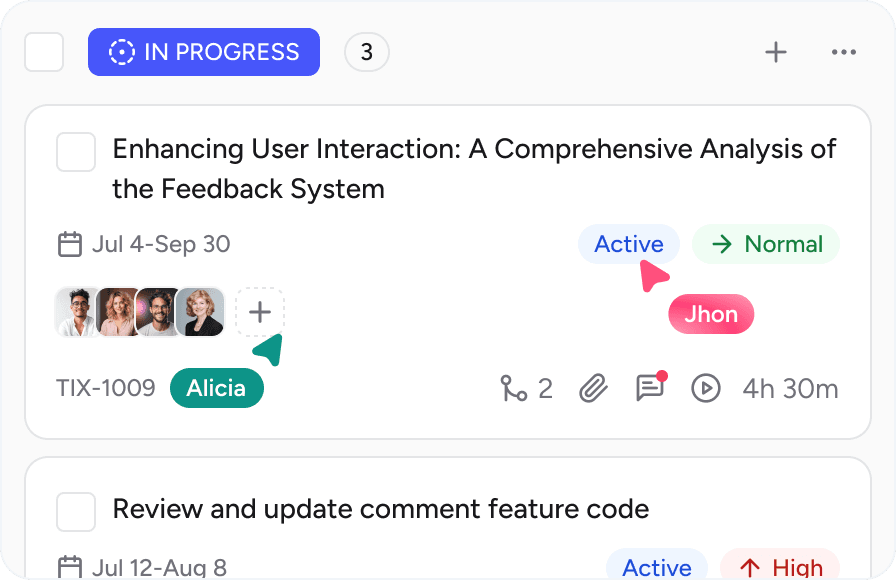
Tixio is designed precisely for this scenario: a unified workspace where small teams manage tasks, build a shared knowledge base, organize links and resources, and keep team communication structured - without needing to maintain a separate project management tool, wiki, and chat app. For remote and hybrid small business teams especially, the single-pane-of-glass approach significantly reduces the "where does this live?" friction that slows small teams down disproportionately.
Notion has become the default recommendation in this space for good reason. Its flexibility means you can build almost any workflow you need - project tracking, meeting notes, SOPs, client databases - but that flexibility is a double-edged sword. Teams without someone willing to architect and maintain the workspace often end up with a Notion that becomes increasingly cluttered and hard to navigate over time. It rewards investment; it punishes neglect.
Basecamp takes the opposite philosophy - opinionated structure, fewer features, clear norms baked into the product design. For small businesses that want to adopt something and not think about it again, Basecamp's simplicity is a genuine feature. Its flat pricing (one price for unlimited users) also makes the budget math unusually predictable.
When You Do Need Dedicated Tools
There are scenarios where small businesses genuinely benefit from specialized tools, even if the default recommendation is consolidation.
If your business runs on project delivery - agency work, consulting, software development, construction management - you probably need dedicated project management software with features like Gantt views, resource allocation, or client-facing portals that all-in-one workspaces don't do well. In this case, tools like Linear (for software teams), Teamwork (for agencies), or Monday.com (for operations-heavy teams) earn their place in the stack.
If your team is highly distributed and relies heavily on real-time communication, a dedicated chat platform like Slack or the more async-friendly Twist will serve you better than the messaging features built into most all-in-one tools. The key is to establish clear norms immediately: which conversations happen in which channels, what counts as urgent versus non-urgent, and how you avoid Slack becoming a stream of noise that everyone eventually mutes.
If you have a meaningful content or documentation function - you're building SOPs, creating training materials, or maintaining a help center - you might want a dedicated knowledge management tool like Notion, Confluence, or GitBook even if you're using a different tool for task management. Documentation compounds in value, and the tool you choose to manage it should be designed to scale.
The Mistakes Small Businesses Consistently Make
The most common collaboration mistake small businesses make isn't choosing the wrong tool - it's choosing the right tool and then not establishing clear norms around how it's used.
A project management tool where half the tasks have no owner, no due date, and no status update is worse than a shared spreadsheet, because it creates a false sense of organization. A knowledge base where pages are created once and never updated is worse than nothing, because it spreads misinformation. A chat tool where every message carries the implicit expectation of an immediate response trains your team to stay in a reactive, distracted mode all day.
The tools are infrastructure. The norms are the culture that makes infrastructure useful. Before rolling out any collaboration platform, spend as much time designing your team's usage norms as you spend evaluating features. Agree on how tasks get created and updated. Agree on what gets documented and where. Agree on response time expectations for messages. Write those norms down, put them somewhere everyone can find them, and revisit them as your team grows.
Practical Recommendations by Business Size
For teams of 5 to 15 people, simplicity and adoption rate matter more than feature depth. Start with one all-in-one tool and use it for everything - tasks, docs, and communication. Add specialized tools only when you hit a clear ceiling. Tixio, Notion, or Basecamp are strong starting points depending on whether you prioritize integration, flexibility, or simplicity respectively.
For teams of 15 to 50 people, you've likely outgrown the "one tool does everything" phase and need more separation of concerns. A dedicated project management tool becomes worthwhile, and you'll likely want a proper wiki or knowledge base separate from your task manager. The stack at this stage typically looks like: a collaboration workspace or wiki for documentation, a project or task management tool for execution tracking, and a communication tool with clear async norms.
Regardless of size, budget for onboarding and norm-setting. The ROI on a tool your team uses with discipline vastly exceeds the ROI on a more expensive tool that gets used inconsistently.
The Long View
The small businesses that invest in collaboration infrastructure early - even imperfectly - build an organizational muscle that pays dividends at every subsequent stage of growth. The processes get clearer, the onboarding gets faster, the institutional knowledge accumulates rather than walking out the door with every departure.
You don't need the perfect tool. You need a good tool, used consistently, with clear norms. That combination outperforms expensive, sophisticated software used haphazardly every single time.
Tixio is built for small and growing teams that want a clean, unified workspace without enterprise complexity. One place for your team's tasks, docs, and shared resources - starting free.