.png)
Slack changed how teams communicate. It made real-time messaging the default, killed most internal email, and became the place where everything important happened in conversation. The problem is that conversation is not the same as work. And in 2026, the teams paying $7 to $12 per person per month for a chat app are asking whether that money could do more. Here is the honest answer.
Why You Are Comparing These Two
Comparing Tixio and Slack might seem like comparing a car to an engine. Slack is a communication tool. Tixio is a Work OS. They are not the same category.
But the comparison is worth making because of a specific problem that almost every Slack team shares. Slack is where decisions get made. Work lives somewhere else. The gap between those two places is where context gets lost, tasks get missed, and team members spend significant time each week translating conversations into actions across tools that were never designed to connect.
The question is not whether Slack is good at what it does. It is very good at what it does. The question is whether what it does is enough, and whether paying $7 to $12 per person per month for a communication tool makes sense when a modular Work OS that includes communication costs $2.80 per person per month.
What Slack Actually Does
Slack is a team communication platform. Channels, direct messages, threads, file sharing, voice and video calls, and a massive library of integrations with other tools. It is fast, searchable, and genuinely well-designed for the communication use case.
Slack's integrations are a major part of its value proposition. Connecting Slack to Jira, Notion, Google Drive, GitHub, and dozens of other tools means that notifications, updates, and alerts from those tools surface in Slack channels. This makes Slack feel like a coordination hub even though it is fundamentally a communication tool.
The problem is that integrations are not the same as integration. Receiving a notification in Slack that a Jira ticket was updated does not connect the conversation about that ticket to the ticket itself. It surfaces information in Slack and requires someone to switch to Jira to act on it. The context gap between conversation and work remains. Slack just makes it feel slightly less wide.
What Tixio Actually Does
Tixio's Chat module covers everything Slack covers for team communication. Channels organised by team, project, or topic. Direct messages for one-on-one and small group conversations. Threaded discussions that keep conversations focused. File sharing, voice notes, and rich message formatting.
The difference is what Chat connects to. In Tixio, a conversation about a project task is linked to that task. A decision made in a channel becomes a documented action in Projects. A question about a client becomes a note in the CRM. A discussion about a policy links to the wiki page where that policy lives. The context gap that defines the Slack experience does not exist in Tixio because communication and work live in the same system.
Feature by Feature: The Real Comparison
Team Communication
Slack's communication features are genuinely excellent. The channel organisation, thread management, search functionality, and notification controls are all well-designed and refined over years of iteration. For pure communication capability, Slack is one of the best tools in its category.
Tixio's Chat module covers the core of what teams actually use in Slack. Channels, DMs, threads, file sharing, and voice notes all work as expected. The interface is clean and fast. The search works across conversations and linked documents simultaneously.
Where Tixio's Chat is different is in context. Every conversation can be linked to a project, a wiki page, a CRM record, or an HR process. When a team member mentions a task in a channel, that mention links to the actual task. When a decision is made in a thread, turning it into a task takes one click rather than a context switch to another tool.
For pure communication depth and the richest set of communication-specific features, Slack has an edge built from years of focused development. For communication that is connected to the work it relates to rather than running parallel to it, Tixio wins.
Integrations
Slack's integration library is one of its strongest competitive advantages. Thousands of integrations connect Slack to almost every tool a team uses. Notifications, workflows, and data from external tools surface in Slack channels automatically.
Tixio takes a different approach. Instead of integrating with external tools, Tixio replaces the need for most of them. The tools teams integrate with Slack, including project management, documentation, HR platforms, and CRM systems, are modules inside Tixio. The integration overhead, the maintenance burden, and the cost of those additional tools disappear when they are not separate tools at all.
For teams that need Slack to connect a large, complex, non-negotiable stack of enterprise tools, Slack's integration ecosystem is unmatched. For teams that are open to consolidating their stack, the integration question becomes irrelevant.
Search and Knowledge Management
Slack's search is powerful within conversations. Finding a message, a file shared in a channel, or a link posted months ago is generally fast and reliable. What Slack cannot search is the work that the conversation was about, because that work lives somewhere else.
Tixio's search covers conversations, wiki pages, project tasks, CRM records, and HR documents simultaneously. When you search for a client name, you find the CRM record, the related project, the relevant wiki page, and the conversations that mentioned them in one search result set.
Winner: Tixio for finding both conversations and the work they relate to.
Project Management
Slack has no project management. Slack workflows and Canvas (Slack's basic document feature) add lightweight task and document capabilities, but they are not a project management system. Slack teams run Jira, Asana, ClickUp, or Trello alongside it.
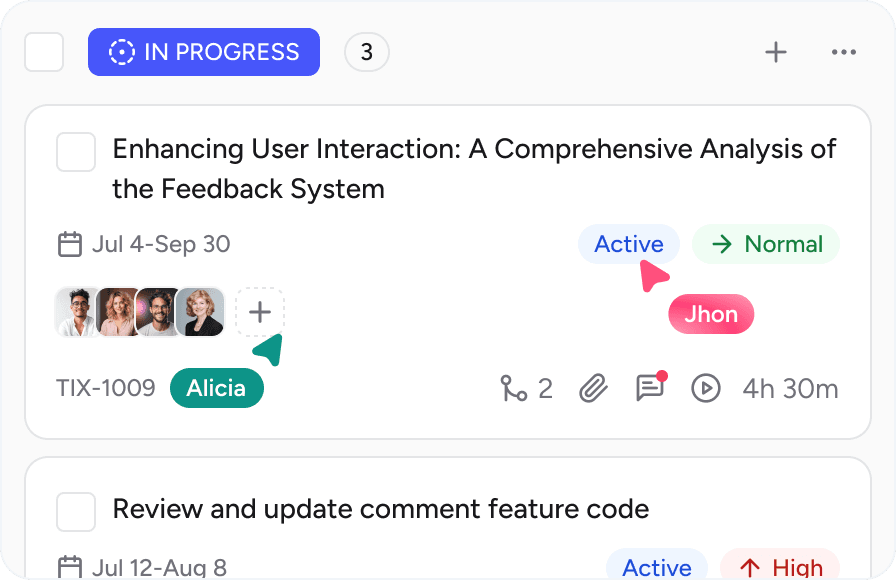
Tixio's Projects module covers kanban, sprint, roadmap, list, and calendar views with full task management, assignments, deadlines, and automation. No additional tool required.
Winner: Tixio.
Documentation
Slack has Canvas, a basic document editor added to Slack channels. It is useful for lightweight notes and meeting summaries that live in context with a channel. It is not a wiki or a knowledge management system.
Tixio's Wiki is a full knowledge management module with structured pages, nested documentation, search, version history, and connection to the rest of the workspace.
Winner: Tixio.
CRM and HR
Slack has neither. Both require separate tools that integrate with Slack via the integrations library. Tixio covers both natively.
Winner: Tixio.
Pricing: The Honest Comparison
Slack's pricing in 2026 sits at $7.25 per user per month for the Pro plan and $12.50 per user per month for the Business+ plan. These prices are for a communication tool only. Teams on Slack still need project management, documentation, CRM, and HR tools alongside it.
A 20-person team on Slack Pro pays $145 per month for communication alone. Add a project tool, a wiki, a CRM, and an HR platform and the total stack cost lands between $400 and $700 per month.
The same 20-person team on Tixio pays $56 per month with chat, projects, wiki, CRM, HR, and canvas all included.
The annual difference is between $4,000 and $8,000 for a 20-person team. That is a significant number for a growing company to reconsider.
The Slack Lock-In Problem
Slack has become infrastructure for many teams. Years of message history, shared files, channel organisation, and workflow automations create a switching cost that goes beyond the subscription fee. Leaving Slack means leaving that history, rebuilding those workflows, and asking your team to change a communication habit that is deeply embedded in their daily routine.
This is worth acknowledging honestly. For teams where Slack is truly infrastructure, the switching cost is real. Tixio's answer to that is a migration path that imports existing documentation and a Chat module that is intuitive enough for teams to adopt quickly, combined with the argument that the cost of staying on Slack and the tools around it is a recurring and growing expense that consolidation on Tixio eliminates.
Where Slack Wins
Slack is the right choice for teams that need the richest possible communication experience with the deepest possible integration ecosystem, where those integrations connect a large, non-negotiable enterprise tool stack that Tixio cannot replace. For large organisations running Salesforce, Workday, and a custom development environment, Slack's integrations connect those systems in ways that a modular Work OS is not attempting to compete with.
Slack is also the right choice for teams where communication is the primary coordination mechanism and the tools alongside it are considered and intentional rather than accumulated accidentally.
Where Tixio Wins
Tixio wins for teams that have Slack and a project tool and a wiki and a CRM and an HR platform and are paying for all of them separately while watching context fall through the gaps between them every single day.
It wins on price by a margin that compounds significantly at scale. It wins on connected context, where conversations and work exist in the same system rather than running parallel to each other. It wins for teams that are ready to consolidate rather than integrate, and for growing companies that cannot justify $7 to $12 per person per month for a communication tool when a complete Work OS costs $2.80 per person per month.
FAQs
Is Tixio a good alternative to Slack? Yes, especially for teams that are running Slack alongside other tools and paying for each separately. Tixio's Chat module covers the core of what teams use Slack for, connected to the projects, wiki, CRM, and HR that live in the same workspace.
Does Tixio have channels and direct messages like Slack? Yes. Tixio's Chat module includes channels, direct messages, threads, file sharing, and voice notes. The experience is clean, fast, and intuitive for teams moving from Slack.
Can Tixio replace Slack entirely? For most growing teams, yes. Teams that rely heavily on Slack's enterprise integrations with large external tool stacks may find those integrations harder to replicate. For teams using Slack primarily for internal communication alongside standard productivity tools, Tixio replaces both Slack and those tools in one workspace.
Which is cheaper, Tixio or Slack? Tixio starts at $2.80 per person per month with all modules included. Slack Pro costs $7.25 per user per month for communication only, with additional tools required for everything else. For most team sizes, Tixio costs significantly less in total.
Who is Slack best suited for? Slack is best suited for large organisations with complex enterprise tool stacks that require deep integration, and for teams where communication tooling is considered, intentional, and not easily replaced. For growing teams running Slack as part of an accumulated tool stack, Tixio consolidates that stack at a fraction of the cost.