Remote work used to be an edge case. Now it's the default. And even teams that work in the same office have discovered that physical proximity alone doesn't produce alignment, speed, or clarity. That's precisely why team collaboration tools have gone from "nice to have" to the operating system of modern work.
But if you've ever searched for the right collaboration tool and found yourself staring at a sea of overlapping software categories - project managers, wikis, chat apps, whiteboards - you've probably asked a very reasonable question: what exactly *is* a team collaboration tool, and what separates a genuinely useful one from more noise in your stack?
This article answers that clearly, and gives you a framework for thinking about what your team actually needs.
The Definition Worth Using
A team collaboration tool is any software that helps two or more people work toward a shared goal - coordinating their efforts, sharing information, tracking progress, and communicating - without requiring them to be in the same physical location or working at the same time.
That last part is crucial. The best collaboration tools are designed for *asynchronous* work as much as real-time work. They acknowledge that your team in Singapore and your team in São Paulo are not going to be online simultaneously, and they make that fact a feature rather than a problem.
The category is broad by design. It includes messaging platforms like Slack, project management tools like Asana or Linear, wikis and knowledge bases like Notion or Confluence, video meeting software like Zoom, whiteboards like Miro, and all-in-one workspaces like Tixio that combine several of these functions. What ties them together is the intent: structured, visible, persistent collaboration that doesn't depend on physical presence or perfect timing.
Why This Category Exists - and Why It Matters Now More Than Ever
For most of human history, workplace collaboration happened through proximity. People sat near each other, overheard each other's conversations, gathered around whiteboards, and made decisions in hallways. Information spread through osmosis. You knew what your colleague was working on because you could see them working on it.
That model was never perfectly efficient - hallway conversations excluded people, institutional knowledge lived in individual heads, and meetings consumed enormous amounts of time. But it worked well enough that most organizations never felt the urgency to replace it with something more structured.
The pandemic didn't just send people home. It ripped away every informal mechanism that organizations had been quietly depending on, and made the structural gaps impossible to ignore.
A 2021 McKinsey study found that
58% of Americans with the option to work remotely were doing so at least part of the time.
Globally, Microsoft's Work Trend Index reported that
The number of meetings per person had increased 252% since February 2020
a sign that teams were trying to compensate for lost proximity with more calls, rather than with better systems.
The organizations that handled this shift well did something counterintuitive: they reduced meetings by investing more heavily in collaboration tools that made synchronous communication less necessary. When everyone can see the state of a project at any moment, you don't need a standup to find out. When decisions are documented in a shared workspace, you don't need to ask someone what was decided. Structure replaces presence.
The Five Things a Good Collaboration Tool Actually Does
Rather than thinking about collaboration tools by software category, it helps to think about the five functions that any team needs covered, regardless of what tool covers them.
Communication
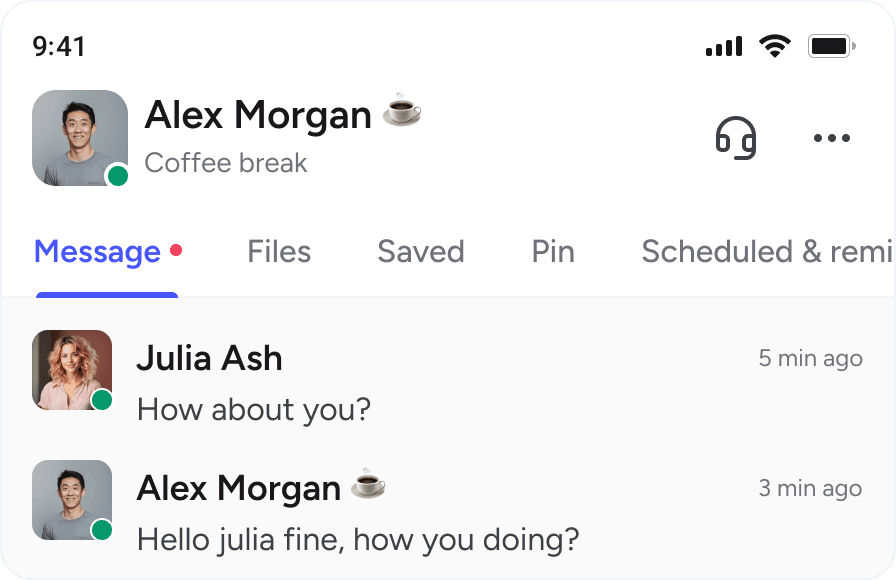
Communication is the most obvious. Your team needs a way to exchange messages, share updates, and have conversations without scheduling a meeting for every question. Asynchronous messaging - where you write, the other person responds when it makes sense - is the core of this. Good collaboration tools structure this communication so it's searchable, organized by context, and doesn't disappear into someone's inbox.
Task and project visibility
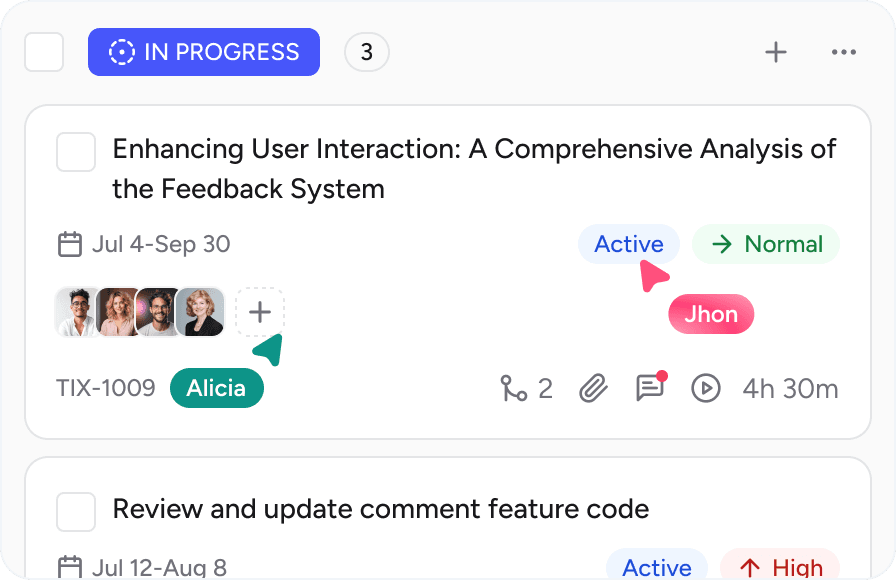
Task and project visibility is the function most often underinvested in. Everyone on your team should be able to see, at any moment, what's being worked on, who owns it, what the status is, and when it's due. This sounds basic, but most teams still manage this through a mix of spreadsheets, verbal check-ins, and tribal knowledge - which means visibility exists only for people who know where to look and who to ask.
Documentation and knowledge management
Documentation and knowledge management is the collaboration function with the highest long-term return. Every time your team figures something out - a process, a decision, a technical approach - and writes it down in a shared, findable place, you've created organizational capital. Every time that knowledge stays in someone's head or a private email thread, you've created organizational debt. Buffer's remote work research found that lack of documentation is one of the top three collaboration challenges for distributed teams, year after year.
File and resource sharing
File and resource sharing seems mundane but compounds quickly. Teams that have a single, organized place where all project files, assets, and references live move measurably faster than teams hunting across email attachments, Dropbox folders, and Google Drive links. Friction in finding resources is a hidden time tax on every piece of work.
Feedback and review loops
Feedback and review loops complete the picture. Collaboration isn't just about broadcasting updates - it's about iterating together. The best collaboration tools create structured ways to give feedback, approve work, and track revisions so that the review cycle doesn't devolve into email chains or comment threads that nobody can follow.
The Difference Between Collaboration Tools and Communication Tools
This distinction matters more than most teams realize. A communication tool - email, SMS, even Slack - is designed to move messages between people. A collaboration tool is designed to move *work* forward. These are related but fundamentally different functions.
You can have excellent communication in an organization and still have dismal collaboration. Teams that are in constant contact but lack structured workflows, shared visibility, and documented processes are often *more* dysfunctional than quieter teams with better systems, because the noise of constant communication masks the absence of genuine coordination.
When evaluating any platform, ask this question: does this tool help us communicate *about* work, or does it help us actually *do* the work together? The best modern tools - and Tixio is built around exactly this principle - try to collapse the distinction. Your communication about a task lives next to the task itself. Your documentation lives alongside the project it belongs to. Context doesn't get lost in transit.
Who Needs Team Collaboration Tools (Hint: Everyone, But Urgently These Teams)
The short answer is that any team larger than two people working toward a shared goal benefits from structured collaboration tools. But the urgency scales with a few specific factors.
Remote and distributed teams feel the pain first and most acutely, because they lack every proximity-based fallback. If your team is distributed across cities, time zones, or continents, collaboration tooling isn't optional infrastructure - it's the only infrastructure you have.
Fast-growing startups and SMBs hit the wall when they scale past roughly 10–15 people. At that size, the founder can no longer hold context for the whole company in their head. Decisions made in one conversation are invisible to people who weren't in the room. Processes that worked on trust and intuition at eight people break down at twenty. Collaboration tools are how you maintain alignment without adding management overhead.
Teams handling complex, interdependent projects - product development, marketing campaigns, client services - need workflow visibility more than teams doing independent work. If the output of one person is the input for another, you need a system that makes dependencies explicit and progress visible.
What to Look for When Choosing One
The market for collaboration tools is crowded and getting more so. When evaluating your options, the questions that cut through the noise are simpler than most vendor comparison guides suggest.
Does the tool reduce your need for meetings, or does it create new coordination overhead? Does it have a sensible learning curve - will your team actually use it, or will it become shelfware? Does it work well for asynchronous communication, not just real-time? Does it integrate with the tools you already depend on? And critically: does it have a mobile experience your team will actually tolerate, given that work increasingly happens away from a desk?
The answers to those questions will narrow your options faster than any feature checklist.
The Bottom Line
Team collaboration tools are not productivity software in the traditional sense - they're not about making individual workers faster. They're about making the *space between* your team members work better. The handoffs, the decisions, the shared context, the institutional knowledge - all of it needs a home that isn't someone's inbox or memory.
The companies building that infrastructure now, regardless of whether their teams are remote or co-located, are compounding an organizational advantage that will only grow more significant as the pace of work increases and teams become more distributed. The question isn't whether you need collaboration tools. It's whether the ones you have are actually doing the job.
Tixio is an all-in-one team collaboration workspace designed for startups and growing teams. It brings task management, documentation, and team communication into one place - so your team spends less time coordinating and more time building.