.png)
The Core Question
You're evaluating ClickUp. Maybe you're already using it, or maybe you're about to sign up. Either way, you've landed here because you want to know if there's a better fit.
This comparison cuts through the noise. No padded feature lists, no vague "it depends." Just a direct look at where Tixio and ClickUp differ in 2026 - on pricing, features, HR and CRM capabilities, and how fast your team can actually get to work.
What Each Tool Actually Does
ClickUp pitches itself as "software to replace all software." It covers project management, docs, goals, whiteboards, time tracking, and chat under one roof. Its 2026 roadmap leans heavily into AI with Super Agents and expanded automation workflows. It's one of the most feature-rich platforms on the market.
Tixio takes a different approach. It bundles project boards, team chat, wikis, a collaborative canvas, a native HR module, and a native CRM pipeline into a single workspace. The goal is the same, replace your tool stack, but Tixio prioritizes breadth across operational functions (including HR and sales) over depth in any single area.
Both tools want to be your team's only app. Where they differ is in which workflows they cover and how easy they are to use out of the box.
Feature-by-Feature Comparison
Project Management
ClickUp is hard to beat on pure project management depth. You get Kanban boards, Gantt charts, list views, calendar views, sprints, goals, portfolios, time tracking, and a deep automations engine. If project management is 80% of what your team does, ClickUp gives you more configuration options than you'll likely ever use.
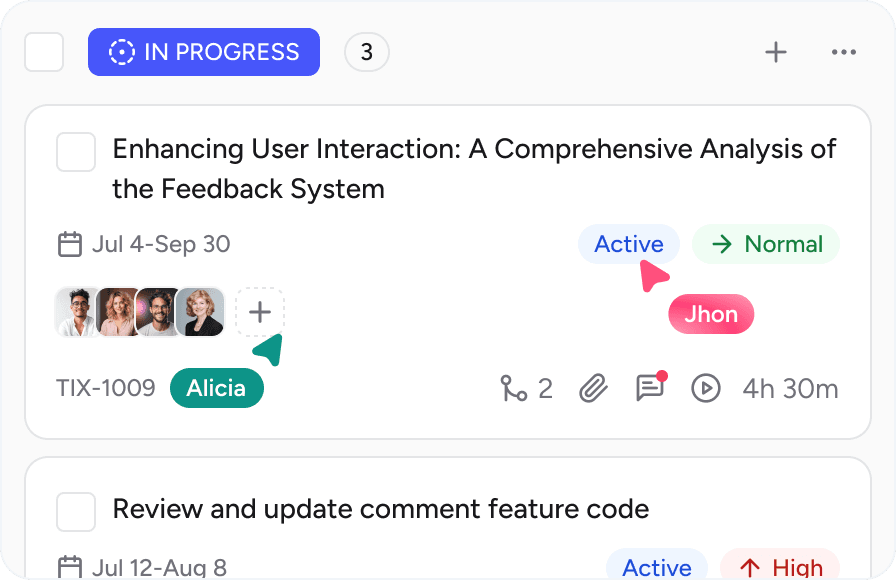
Tixio covers the core well. You get Kanban boards, roadmaps, calendar views, task and subtask tracking, and automations on the Team and Enterprise plans. It handles the workflows most small and mid-sized teams actually need without requiring a week of setup.
Verdict: ClickUp wins on raw project management depth. Tixio wins on getting your team productive faster.
Team Chat and Communication
ClickUp added chat to its platform, but it has historically been treated as a secondary feature. Many teams using ClickUp still run Slack alongside it because ClickUp Chat doesn't feel like a first-class communication tool.
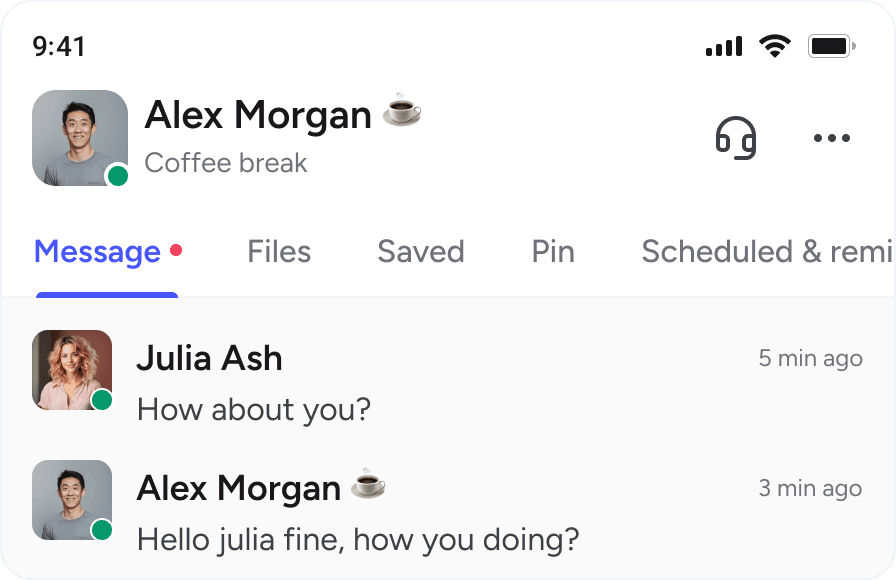
Tixio's chat is built as a core module, not an add-on. You get channels, direct messages, threads, file sharing, and meeting support, all inside the same workspace where your boards and wikis live. Your team doesn't need to jump between apps to follow a conversation and then act on it.
Verdict: Tixio has a more integrated chat experience. ClickUp's chat works, but it's not where teams naturally gravitate.
HR Operations
This is where the comparison gets interesting.
ClickUp has no native HR module. If your team needs leave management, attendance tracking, payroll, employee contracts, or onboarding workflows, you're adding a separate tool. That means another subscription, another login, and another set of data to keep in sync.
Tixio ships a dedicated HR add-on that covers attendance, leave management, payroll, contracts, and employee onboarding. It's $5/month as an add-on, and it lives inside the same workspace your team already uses for chat and project management.
For a 20-person agency or a growing startup that's just hired its fifth or tenth employee, this matters. You don't want to manage people operations in a completely separate system.
Verdict: Tixio wins outright. ClickUp doesn't compete here.
CRM and Sales Pipeline
Same story. ClickUp doesn't offer a native CRM pipeline. You can build a makeshift CRM using custom fields and list views, but it's not the same as a purpose-built sales tool.
Tixio's CRM module includes lead management, deal pipelines, email and calendar integration, and activity tracking. Again, it's a $5/month add-on that sits inside your existing workspace. Your sales team can update a deal, ping a teammate in chat, and check the project status for that client, without leaving the app.
Verdict: Tixio wins. ClickUp requires a third-party CRM integration to match this.
Wikis and Documentation
ClickUp Docs is capable, you can create nested documents, embed content, and link docs to tasks. It's not as flexible as Notion's block-based editor, but it's functional.
Tixio's wiki module handles internal documentation with comments and embeds. It's clean and practical. Not a Notion replacement for teams that live in docs, but solid for teams that need a shared knowledge base alongside their other workflows.
Verdict: Roughly even for most teams. ClickUp has a slight edge in document flexibility; Tixio keeps it simpler.
Pricing: What You Actually Pay
This is where the comparison gets practical fast.

The key difference: Tixio's plans are flat-rate with unlimited seats. ClickUp charges per user.
For a team of 15 people, Tixio's Team plan costs $9/month. ClickUp's Business plan costs roughly $180/month for the same team. Add the HR and CRM add-ons to Tixio and you're at $19/month total. That's still a fraction of what you'd pay for ClickUp plus a separate CRM and an HR tool.
The math shifts if you're a solo operator or a two-person team - ClickUp's free plan is generous and the per-user cost is low at small scale. But as your team grows, Tixio's flat pricing becomes a significant advantage.
See the full breakdown on Tixio's pricing page.
Ease of Use and Onboarding
ClickUp's biggest and most consistent criticism is complexity. The platform has so many views, settings, and configuration options that new team members often spend days just figuring out how to set up a workspace. Small teams frequently report feeling overwhelmed before they've shipped a single project.
Tixio is designed to onboard fast. Start with chat and boards. Add the HR or CRM module when your team is ready. The interface doesn't front-load every feature at once, which means less time configuring and more time working.
This isn't a knock on ClickUp's power, it's genuinely configurable in ways Tixio isn't. But configurability has a cost, and for teams that don't have a dedicated ops person to manage the tool, that cost shows up as friction.
Who Should Choose Tixio
Tixio is the right fit if:
- Your team is 10–100 people and you're paying for 3+ separate tools (Slack, Notion, a CRM, an HR system)
- You want HR and CRM in the same workspace as your projects and chat
- You're budget-conscious and flat-rate pricing matters
- You want to onboard your team in hours, not days
- You're an agency, startup, or consulting firm that manages both client work and internal operations
Tixio offers a 14-day free trial with no credit card required - worth testing before committing to any stack.
Who Should Choose ClickUp
ClickUp is the better fit if:
- Your team is ops-heavy and needs deep project management customization (sprints, portfolios, complex automations)
- You have someone dedicated to configuring and maintaining the workspace
- AI-assisted workflows and automation are a priority for your team in 2026
- You don't need native HR or CRM, you already have those covered by other tools
- You're a mid-market or enterprise team willing to invest setup time for maximum configurability
Head-to-Head Summary

The honest answer: ClickUp wins on raw feature depth. Tixio wins on breadth across business functions, pricing, and how quickly your team gets value.
If you need the most configurable project management tool on the market and have the team to manage it, ClickUp is a strong choice. If you want one workspace that handles your projects, chat, HR, and sales pipeline without the complexity tax, Tixio is worth a serious look.
FAQs
Does Tixio have a free plan? Tixio offers a 14-day free trial with no credit card required. ClickUp has a free-forever plan with limited features. If you need to test before committing, both give you a way to do that, but Tixio's trial gives you full access to evaluate the platform properly.
Does ClickUp have an HR module? No. ClickUp does not include a native HR module. You can build workarounds using custom fields, but leave management, payroll, contracts, and employee onboarding require a separate tool. Tixio's HR add-on covers all of these natively for $5/month.
Is Tixio cheaper than ClickUp for growing teams? Yes, significantly, once your team grows beyond a handful of people. Tixio's pricing is flat-rate with unlimited seats, the Team plan is $9/month regardless of how many people you add. ClickUp charges per user, so a 15-person team on the Business plan pays roughly $180/month. Adding HR and CRM add-ons to Tixio still keeps the total well below that.
Can Tixio replace Slack and a CRM at the same time? That's exactly the use case Tixio is built for. The chat module handles channels, direct messages, threads, and file sharing. The CRM add-on covers lead management, deal pipelines, and email integration. Both live inside the same workspace, so your team doesn't need separate logins or context-switching.
Is ClickUp better for large enterprise teams? ClickUp has stronger enterprise features in terms of AI automation, deep integrations, and configurability. Tixio also offers enterprise pricing with custom options including SSO, SAML, API access, and audit logs. For teams that need HR and CRM bundled with collaboration at enterprise scale, Tixio is worth evaluating alongside ClickUp.
How long does it take to set up Tixio vs ClickUp? Most teams get Tixio running the same day. ClickUp's setup is more involved, the platform's flexibility means more decisions upfront, and many teams spend days configuring views, hierarchies, and automations before they're productive. If speed to value matters, Tixio has the edge.
Which tool is better for agencies? Agencies managing client projects, internal communication, and business development tend to get more out of Tixio because the CRM and chat are native to the workspace. You can track a deal, manage the project, and keep the team aligned without switching apps. Tixio also has a dedicated agencies solution page if you want to see how it maps to agency workflows specifically.