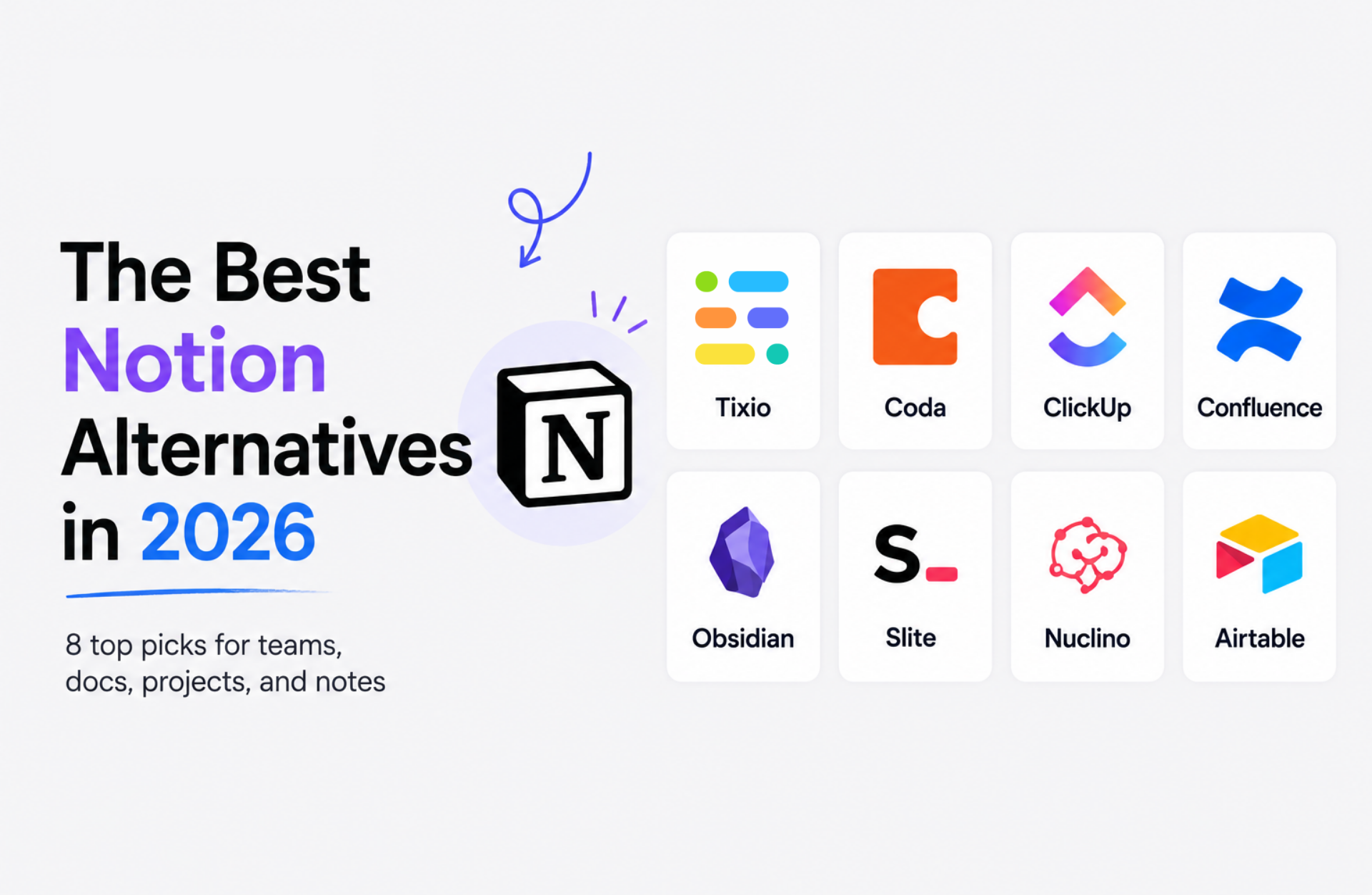
The best Notion alternatives in 2026 are Tixio for teams that want wiki, chat and projects in one workspace, Coda for doc-driven databases, ClickUp for heavy project management, Confluence for engineering documentation, Obsidian for private local-first notes, Slite and Nuclino for lightweight team wikis, and Airtable for structured data. Every price below was checked in August 2026.
Why teams look for a Notion alternative
Three reasons come up again and again. Notion has no built-in team chat, so it sits beside Slack rather than replacing it. Cost climbs quickly once a team moves from Plus at $10 per member to Business at $20. And permissions get awkward when contractors, guests and departments all need different access to the same page tree.
Quick comparison
- Tixio: A full workspace suit- projects, chat, HR & CRM, from $2.80 per user/month
- Coda: doc-driven databases and formulas, free, then $12 per Doc Maker/month
- ClickUp: deep project management, free, then $7 per user/month
- Confluence: engineering and product documentation, free to 10 users, then $5.42 per user/month
- Obsidian: private, local-first notes, free, Sync $4 per user/month
- Slite: an AI-searchable team wiki, $10 per user/month
- Nuclino: a fast, minimal wiki, free, then $6 per user/month
- Airtable: structured data and internal apps, free, then $20 per seat/month
1. Tixio: best all-in-one Notion alternative
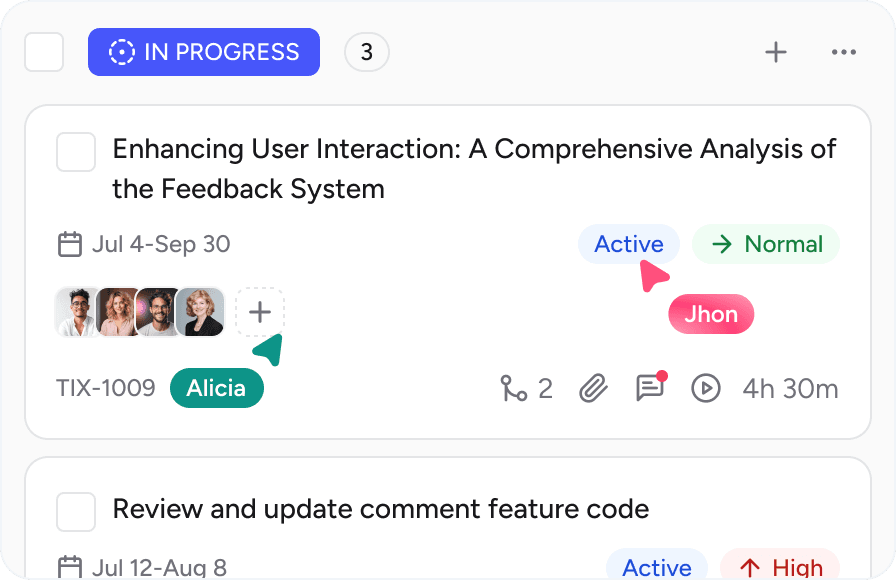
Tixio is one workspace holding wiki, project boards, chat, canvas, bookmarks and start-page dashboards, with optional HR and CRM modules. It is the closest thing here to Notion plus Slack on a single bill. We build Tixio, so read the trade-off line as the honest part.
- Best for: small and mid-size teams replacing Notion, a chat app and a project tool at once
- Pricing: Starter $2.80 and Team $6.30 per person/month billed yearly ($4 and $9 monthly). HR and CRM add-ons are $5/month each. 14-day trial, no credit card
- Strength: role-based access control and object-level security on the Team plan, which normally appears only on far more expensive tiers
- Trade-off: no offline-first editing, and the third-party integration library is much smaller than Notion’s
2. Coda: best for doc-driven databases
Coda treats a document as a database. Tables, buttons, formulas and packs let a single doc behave like a small internal app, which suits operations and revenue teams that outgrew Notion databases.
- Best for: ops teams building trackers, calculators and approval flows inside docs
- Pricing: free plan; Pro $12 and Business $33 per Doc Maker/month billed annually ($15 and $40 monthly)
- Trade-off: billing per Doc Maker makes budgets hard to predict, and the formula language has a real learning curve
3. ClickUp: best for project execution
ClickUp is the most feature-dense option on this list: tasks, docs, whiteboards, goals, time tracking and chat. If the real problem is shipping work rather than writing it down, it is a bigger step up than Notion.
- Best for: teams whose main job is delivering projects against deadlines
- Pricing: Free Forever; Unlimited $7 and Business $12 per user/month billed yearly ($10 and $19 monthly)
- Trade-off: setup is heavy and new users routinely describe the interface as overwhelming
4. Confluence: best for engineering documentation
Confluence is Atlassian’s documentation product and the default choice if your engineers already live in Jira. Spaces, page trees, templates and approvals are mature, and the Jira link is native.
- Best for: engineering and product organisations already on Atlassian
- Pricing: free up to 10 users; Standard $5.42 and Premium $10.44 per user/month
- Trade-off: the editing experience feels dated next to Notion, and much of the value disappears if you do not use Jira
5. Obsidian: best for private, local-first notes
Obsidian stores notes as plain Markdown files on your own machine. Nothing is hosted unless you pay for Sync, which makes it the pick for people who want ownership, portability and offline access.
- Best for: individuals, researchers and writers who want to own their files
- Pricing: free to use; Sync $4 per user/month billed annually; Publish $8 per site/month; commercial-use licence $50 per user/year
- Trade-off: real-time multiplayer editing is not its strength, so it is a weak fit for a shared company wiki
6. Slite: best for keeping documentation trustworthy
Slite is a focused team wiki with AI search and a verification workflow that flags pages going stale, which is a genuine gap in Notion.
- Best for: teams whose documentation quietly rots and nobody notices
- Pricing: Basic $10 and Pro $20 per user/month billed yearly; Enterprise on request
- Trade-off: no free plan, and no project management, so it replaces only part of Notion
7. Nuclino: best lightweight wiki
Nuclino is deliberately small: fast pages, nested items, graph and board views, almost no configuration. Teams that found Notion sluggish often take to it within an hour.
- Best for: small teams that want a wiki running the same day
- Pricing: free up to 50 items; Starter $6 and Business $10 per user/month
- Trade-off: limited formatting and no real task management
8. Airtable: best for structured data
Airtable is a relational database with interfaces layered on top. If what you actually liked about Notion was its databases, this is the stronger version of that idea.
- Best for: structured records, inventories, content calendars and internal tools
- Pricing: free plan; Team $20 and Business $45 per seat/month billed annually ($24 and $54 monthly)
- Trade-off: expensive per seat, and a poor document editor
Where Tixio is not the right choice
Being clear about this saves everyone a trial. Tixio is the wrong pick if any of these apply:
- Deep issue tracking. If you need sprints, story points and git integration, use Jira or Linear
- Self-hosting. Tixio is cloud-only, with no on-premise deployment or choice of data region
- SSO/SAML on a cheap plan. Single sign-on sits on the Enterprise tier, not on Starter or Team
- A large integration marketplace. Notion, ClickUp and Atlassian all have far bigger app ecosystems
- Public product documentation. Tixio wikis are for internal knowledge, not customer-facing help centres
- Offline, local-file notes. Obsidian is simply the better tool for that
How to choose
Pick by the problem you are actually solving. Replacing several subscriptions at once points to Tixio. Documentation alone points to Slite, Nuclino or Confluence. Project delivery points to ClickUp. Structured data and internal apps point to Airtable or Coda. Private personal notes point to Obsidian.
Prices were taken from each vendor’s own pricing page in August 2026 and are in USD. Vendors change pricing often, so confirm before you buy.