.png)
The best Obsidian alternatives in 2026 are Logseq for outliners, Notion for structure and collaboration, Tixio when the notes need to be a team's rather than yours, Joplin for open source with encryption, Anytype for local first with a friendlier interface, Craft for Apple users, and plain markdown files if you have realised the tool was never the point.
Obsidian is excellent and most people asking this question do not actually have a problem with it. They have a problem with what it demands: you build the system, you maintain the plugins, and none of it is shareable without effort. Those are three different complaints with three different answers.
Why people look for an alternative
Worth naming precisely, because the right replacement depends entirely on which of these is yours.
- Setup burden. Obsidian ships as a blank vault. The plugin ecosystem is a strength and a trap, and a week spent configuring is a week not writing
- Collaboration. Obsidian is fundamentally single player. Sharing a vault with a team means sync services, git, or accepting that it is not really shared
- Mobile friction. Usable, but noticeably heavier than tools designed mobile first, and the sync setup is another decision to make
- Plugin fragility. A vault that depends on six community plugins is a vault that can break on an update, and the maintenance is yours
- Structure. Some people want a database and views, and Obsidian's answer to that is another plugin
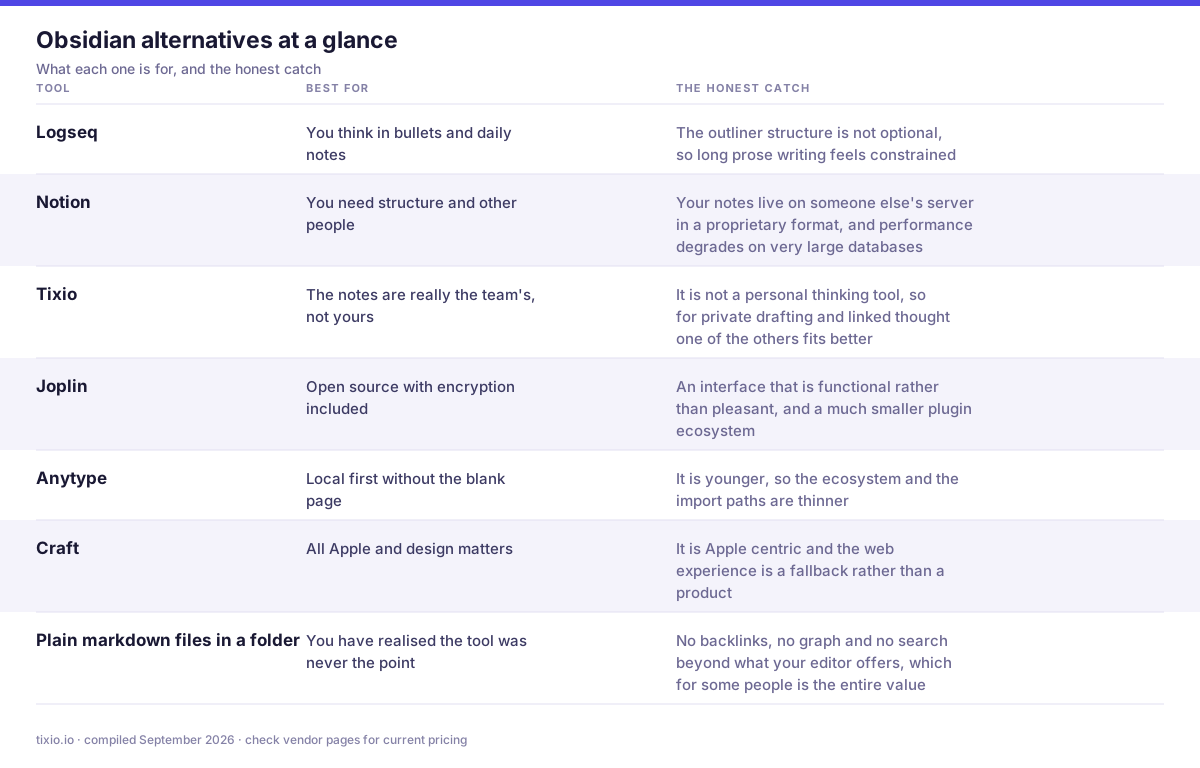
The whole list in one view. The right hand column is the part most comparison posts leave out.
The 7 best Obsidian alternatives
1. Logseq, for outliners and daily notes
Local first, open source, markdown based, and built around an outliner with a daily journal at the centre. If you think in bullets and work from a running daily note, this fits your brain better than Obsidian's page model. Block references are first class rather than bolted on. The catch is that the outliner structure is not optional, so long prose writing feels constrained.
- What it does well: an outliner first model where every block is addressable, plus a daily note workflow that suits people who think by writing rather than by filing.
- Where it bites: development has slowed noticeably, sync is still a beta with no published price, and performance drops on very large graphs.
- Best for: outliner people and daily note journallers who want local markdown.
Pricing: free and open source, described as free forever for personal use, with no paid tier published. Sync is in open beta rather than a paid product, so most people run Git or Dropbox underneath. Logseq
2. Notion, for structure and working with other people
Databases, views, sharing and comments that all work without configuration. Where Obsidian expects you to build a system, Notion hands you one. Genuinely collaborative in a way Obsidian is not. The catch is that your notes live on someone else's server in a proprietary format, and performance degrades on very large databases.
- What it does well: everything Obsidian is deliberately bad at. Sharing, comments, permissions and databases, all working out of the box with no plugin archaeology.
- Where it bites: your notes live on their servers in their format, it is slow offline, and the block limit applies once a workspace has more than one member.
- Best for: people whose notes are read by someone other than them.
Pricing: free plan with block limits on multi member workspaces. Plus $10 per member per month, Business $20, both annual, monthly around 20% higher. Notion and pricing
3. Tixio, when the notes belong to a team
A lot of what sits in a personal vault is really company knowledge held by one person: process notes, client context, how something works, the reading that informed a decision. That is a single point of failure rather than a note taking preference. Tixio keeps that material in a shared workspace next to chat, projects and shared links, with permissions and one search across all of it. The catch is that it is not a personal thinking tool, so for private drafting and linked thought one of the others fits better.
- What it does well: turns private vault knowledge into something a team can find, with docs, chat, tasks and shared links in one workspace and permissions that make sense.
- Where it bites: no local files, no backlink graph and no plugin ecosystem. This is knowledge for a company, not a second brain for one person.
- Best for: people whose vault is quietly holding process documentation their colleagues cannot see.
Pricing: 14 day trial, no card. Starter $2.80 per user per month billed annually ($4 monthly), Team $6.30 annually ($9 monthly), Enterprise on request. Tixio pricing
4. Joplin, for open source with encryption
Open source, markdown, with end to end encrypted sync to storage you choose. The closest thing to Obsidian's ownership model with encryption included rather than assembled. The catch is an interface that is functional rather than pleasant, and a much smaller plugin ecosystem.
- What it does well: the same local markdown promise with end to end encrypted sync you can point at storage you already pay for, plus a proper web clipper.
- Where it bites: the interface is plain next to Obsidian, and mobile is functional rather than pleasant.
- Best for: privacy first note takers who want encryption without running a server.
Pricing: the app is free and open source, and syncing through your own Dropbox, OneDrive, WebDAV or S3 costs nothing. Joplin Cloud starts around 2.40 euros a month billed yearly, Teams around 6.69 euros per user per month. Joplin and plans
5. Anytype, local first with a gentler start
Local first and encrypted like Obsidian, but with objects, relations and templates provided rather than assembled from plugins. A reasonable answer if you liked the philosophy and disliked the blank page. The catch is that it is younger, so the ecosystem and the import paths are thinner.
- What it does well: local first and encrypted like Obsidian, but with objects, relations and types built in, so you get structure without assembling it from plugins.
- Where it bites: the object model takes a mental adjustment, and there is still no published per seat business plan, which makes it awkward to buy for a company.
- Best for: people who wanted Obsidian's ownership model and Notion's structure.
Pricing: free tier with 100MB of remote storage and 10 shared spaces. Plus $4 a month billed yearly, Pro $8, Ultra $16, all gating sync storage rather than features. Anytype and pricing
6. Craft, for Apple users who care how it looks
Beautifully designed, fast, excellent on iPhone and iPad, with sharing that actually works for sending a document to someone. The catch is that it is Apple centric and the web experience is a fallback rather than a product.
- What it does well: the best looking and fastest note app on Apple hardware, with block based documents that are genuinely pleasant to share with clients.
- Where it bites: the free plan stops at 1,500 blocks, the team plan is a flat 10 seat bundle rather than real per seat pricing, and it is Apple leaning.
- Best for: Apple users who care what a document looks like when someone else opens it.
Pricing: free up to 1,500 blocks and 1GB. Plus $6.40 per user per month billed annually ($8 monthly), Family $12 a month for up to 6 accounts, Team $50 a month for up to 10 accounts. Craft and pricing
7. Plain markdown files in a folder, for the honest answer
Worth saying. A folder of markdown files, synced with whatever you already use, opened in any text editor, covers what a large share of Obsidian users actually do. No plugins, no vault, nothing to break, and it will still open in thirty years. The catch is no backlinks, no graph and no search beyond what your editor offers, which for some people is the entire value.
- What it does well: costs nothing, breaks nothing, and outlives every app in this list. Any editor opens it, any sync service moves it, and grep still finds things.
- Where it bites: no backlinks, no graph, no mobile capture worth the name and no search beyond what your operating system gives you.
- Best for: anyone who suspects the tool has become the hobby.
Pricing: free. The only cost is whatever cloud storage you already pay for, and an editor like VS Code, Typora or iA Writer if you want one.
Choosing in one line each
- You think in bullets and daily notes: Logseq
- You need structure and other people: Notion
- The notes are really the team's, not yours: Tixio
- Open source with encryption included: Joplin
- Local first without the blank page: Anytype
- All Apple and design matters: Craft
- You have realised the tool was never the point: plain markdown files
Four questions that decide it
- Do other people need to read this? If yes, stop looking at personal note apps, because every one of them treats sharing as an afterthought
- How many plugins are you running? If it is more than three, your complaint is maintenance and the fix is a tool with fewer moving parts, not a different vault
- Do you want files or a service? Files means Logseq, Joplin or plain markdown, and no future migration. A service means less setup and more dependency
- Are you writing prose or connecting ideas? Prose points at Craft or plain files. Connecting ideas points at Logseq, and honestly points back at Obsidian
Migrating out
Easier than almost any other category, because Obsidian never locked you in. Your vault is already a folder of markdown files on your disk, so the migration is a copy. What does not travel is everything that made it feel like a system: plugin behaviour, dataview queries, canvas files and graph structure. Wiki style double bracket links survive into Logseq and most markdown tools, and break in Notion.
Do the same thing you would do with any move: take the notes you have opened in the last year, leave the rest as an archive folder, and treat the migration as a chance to find out how much of the vault you actually use. For most people it is a small fraction, which is itself useful information.
Related reading
Related reading: personal knowledge management, 9 best reference management software tools, and 7 best Pocket alternatives.
The short version
Logseq if you think in bullets, Notion if you need structure and other people, Joplin if you want ownership with encryption. If your real problem is that the notes are company knowledge sitting in one person's vault, no personal note app fixes that. And if you are running six plugins to make Obsidian behave, the honest alternative might be a folder of markdown files.