.png)
An employee communication app is the one place your team gets messages, announcements and answers, on desktop and phone. To choose one people will actually open, score tools on adoption, mobile, search, async, announcements, permissions, integrations and price per seat, then pilot your top two for 30 days with real work.
The uncomfortable truth: most companies do not have a communication problem. They have five communication tools, a shared drive nobody can search, and a CEO who thinks "I posted it in #general" means everyone read it. Let's fix that without buying a sixth tool.
What is an employee communication app (and what it is not)
The category name is messy, and vendors like it that way. "Employee communication app" can mean a Slack-style chat tool, a glossy intranet, or a mobile feed for warehouse staff. These are very different products that solve very different problems.
Before you compare features, decide which job you are hiring the tool for.
Chat apps
Slack, Microsoft Teams and Google Chat live here. They are built for fast, two-way conversation: channels, DMs, threads, huddles. They are great for teams that sit at a laptop all day and talk to each other constantly.
They are weaker at one-to-many communication. An important announcement in a busy channel has the shelf life of a banana.
Intranets and employee communication platforms
Staffbase, Workvivo and Simpplr live here. An employee communication platform is built for the company talking to its people: news, CEO updates, campaigns, policies, surveys, and analytics on who read what.
They are strong on reach and measurement, but usually not where daily work happens. People visit when they have to.
Frontline apps
Connecteam and similar tools are built for people who do not sit at a desk: shift workers, field technicians, retail, hospitality. They bundle chat and updates with things like scheduling, time clocks and forms, and they are designed phone first.
All-in-one work apps
A newer group puts chat next to the actual work: projects, docs, HR requests, sometimes CRM. The idea is simple: if the message about the project lives next to the project, nobody has to go hunting.
None of these is "best." The best internal communication software is the one that matches where your people spend their day and what they most need to hear.
The real cost of bad internal communication
Bad internal communication rarely shows up as a line item. It shows up as rework, missed handovers and three people asking the same question. The research is consistent:
- Business leaders estimate their teams lose 7.47 hours per week to poor communication, according to the Grammarly and Harris Poll State of Business Communication report (2022). That is nearly a full working day.
- The same report puts the cost at up to $1.2 trillion a year for U.S. businesses, or $12,506 per employee per year.
- In that survey, 72% of business leaders said their team had struggled to communicate effectively over the past year.
- Atlassian's State of Teams 2025, based on 12,000 knowledge workers and 200 executives, found that leaders and teams spend 25% of their time just searching for answers.
- The McKinsey Global Institute (2012) estimated the average interaction worker spends 28% of the workweek managing email and nearly 20% looking for internal information or tracking down colleagues. It also found a searchable record of messages can cut time spent searching for company information by as much as 35%.
Then there is engagement, which is where communication quietly turns into a people problem.
- Gallup's State of the Global Workplace 2026 puts global employee engagement at 20% in 2025, down from 21% the year before. Gallup estimates low engagement costs the world economy about $10 trillion in lost productivity, or 9% of GDP.
- Manager engagement fell to 22% in 2025, down from 27% in 2024. Managers are the people who are supposed to relay information. When they check out, the message chain breaks.
- In the U.S., Gallup's January 2026 update found 31% of employees engaged and 17% actively disengaged in 2025.
- The biggest drop in that U.S. data was clarity of expectations ("I know what is expected of me at work"), down 9 points since 2020. When asked what would help most, 35% said better communication. Not a pay rise, not a ping-pong table. Better communication.
So the tool matters. But only if people actually open it.
Worked example: what searching costs a 50-person team
Let's do the math for a 50-person company. We will be deliberately conservative.
For the hourly cost, use the U.S. Bureau of Labor Statistics figure: median usual weekly earnings for full-time workers were $1,251 in Q2 2026. Divide by 40 hours and you get about $31.28 per hour. That is salary only, before taxes, benefits or office costs, so the real number is higher.
The headline version (Atlassian's 25%):
- A 40-hour week times 25% is 10 hours per person spent searching for answers.
- 10 hours times 50 people is 500 hours per week.
- 500 hours times $31.28 is $15,640 per week.
- Over 48 working weeks, that is $750,720 per year.
That number is too large to put in a board deck. Plenty of that searching would happen with any tool.
The skeptical version:
- Assume a better setup saves each person just 1 hour per week, because messages, files and tasks live in fewer places and search actually works.
- 1 hour times 50 people is 50 hours per week.
- 50 hours times $31.28 is $1,564 per week.
- Over 48 weeks, that is $75,072 per year.
Now compare that with software cost. A tool at $10 per seat per month costs 50 times $10 times 12, which is $6,000 a year. Even the skeptical version pays for itself more than 12 times over.
The lesson is not "buy expensive software." It is that the cost of the tool is almost never the expensive part. The expensive part is people hunting for the message that explains what they are supposed to do.
Notification overload: why more channels is not the answer
The instinct when communication is bad is to add a channel. Another Slack channel, another weekly email, another all-hands. Microsoft's data suggests most teams are already drowning.
The Microsoft Work Trend Index special report "Breaking down the infinite workday" (June 2025) found:
- Employees are interrupted every 2 minutes during core work hours by meetings, emails or chats. That is 275 interruptions a day.
- The average worker receives 117 emails a day and 153 Teams messages per weekday.
- 48% of employees (and 52% of leaders) say their work feels chaotic and fragmented.
- 57% of meetings are ad hoc calls with no calendar invite.
- The average employee sends or receives more than 50 messages outside core business hours, and by 10 pm, 29% of active workers are back in their inbox.
- 1 in 3 employees say the pace of work over the past five years has made it impossible to keep up.
Would a new app fix this, or make it worse?
A good employee communication app reduces noise. It separates "you must read this" from "this is a chat about lunch," lets you schedule messages for working hours, and finds last Tuesday's decision without scrolling.
A bad one just adds a 154th message to the pile.
Desk workers vs frontline workers: two different problems
If you take one thing from this guide, make it this: your desk team and your frontline team need different things from internal communication tools.
According to Emergence Capital's deskless workforce report (2020), roughly 80% of the global workforce is deskless, about 2.7 billion people. The same survey of 1,532 deskless workers found 62% were unsatisfied with their technology or saw room for improvement.
That is a lot of people being served by tools designed for someone sitting at a 27-inch monitor.
What desk workers need
- Fast, threaded conversation with their team and other teams.
- Search that finds a message, a file and a decision in one go.
- Integrations with the tools they already use all day.
- Fewer interruptions, not more.
What frontline and deskless workers need
- A phone app that works on a cheap Android, on bad Wi-Fi, in under 10 seconds.
- Announcements they cannot miss, ideally with a read confirmation.
- Shift info, leave requests and "who is working today" in the same place as messages.
- No company email address required to sign in.
- Permissions that keep them out of channels they do not need, so the feed stays relevant.
If you run a mixed workforce, do not assume your desk tool will stretch to the shop floor. Test every employee communication app on your shortlist on the oldest phone in the building.
How to choose an employee communication app: the 8-point scoring framework
Feature checklists are useless because every vendor ticks every box. You need a way to weigh what matters to your team.
Score each tool from 1 (poor) to 5 (excellent) on each criterion, multiply by the weight, and add it up. The maximum score is 500.
- Adoption (weight 20). Will people open it without being nagged? Does it feel like a tool they would choose, or a tool they are made to use? Test this with real users, not the buying committee.
- Mobile (weight 15). Can someone read an announcement, reply in a thread and find a file from a phone in under a minute? For frontline teams, double this weight.
- Search (weight 15). Search for a decision made three weeks ago. Did it show up? Can you search messages, files and tasks together?
- Async (weight 10). Threads, scheduled messages, reminders, saved items. Can people across time zones work without being online at the same time?
- Announcements (weight 10). Can you post one-to-many updates that do not get buried? Pins, dedicated channels, read tracking?
- Permissions (weight 10). Role-based access, guest users for clients or freelancers, groups. Can a contractor see one project without seeing the HR channel?
- Integrations (weight 10). Does it connect to the tools you cannot drop? Or does it replace enough of them that you need fewer integrations?
- Price per seat (weight 10). Not the sticker price. The total cost for your headcount, including add-ons you will actually need, and the tools it lets you cancel.
A quick scoring example
Say you are a 50-person agency comparing two tools.
- Tool A scores 5 on adoption (100), 3 on mobile (45), 3 on search (45), 4 on async (40), 2 on announcements (20), 3 on permissions (30), 5 on integrations (50) and 3 on price (30). Total: 360.
- Tool B scores 4 on adoption (80), 4 on mobile (60), 4 on search (60), 4 on async (40), 4 on announcements (40), 4 on permissions (40), 3 on integrations (30) and 4 on price (40). Total: 390.
Tool A felt better in the demo. Tool B wins on the things that matter after week three. This happens a lot.
The shortlist: 8 employee communication apps worth testing in 2026
Here is a fair shortlist. Prices were checked on each vendor's own pricing page in October 2026 and are in USD. Where a vendor hides its pricing, we say so. Prices change, so confirm before you sign anything.
1. Slack
Best for: desk-based teams that live in chat and use lots of third-party tools.
Slack is still the reference point for team chat: fast, well designed, with a huge app directory. People like using it, which counts for a lot on adoption.
- Price: Pro is $7.25 per user per month billed annually, or $8.75 monthly. Business+ is $15 annually or $18 monthly. Enterprise+ is quote only.
- Free plan: 90 days of message history, up to 10 apps, and huddles limited to 1:1.
- Watch out for: it is a chat tool, not a home for work. Projects, docs and HR still live elsewhere, so search only covers part of the picture. Announcements can get buried in busy workspaces.
If Slack is close but not quite right, our roundup of the best Slack alternatives in 2026 goes deeper.
2. Tixio
Best for: small and mid-size teams that want chat, announcements and the work itself in one app, instead of five.
We build Tixio, so read this one with that in mind. Our bet is that internal communication works best when messages live next to the work they are about.
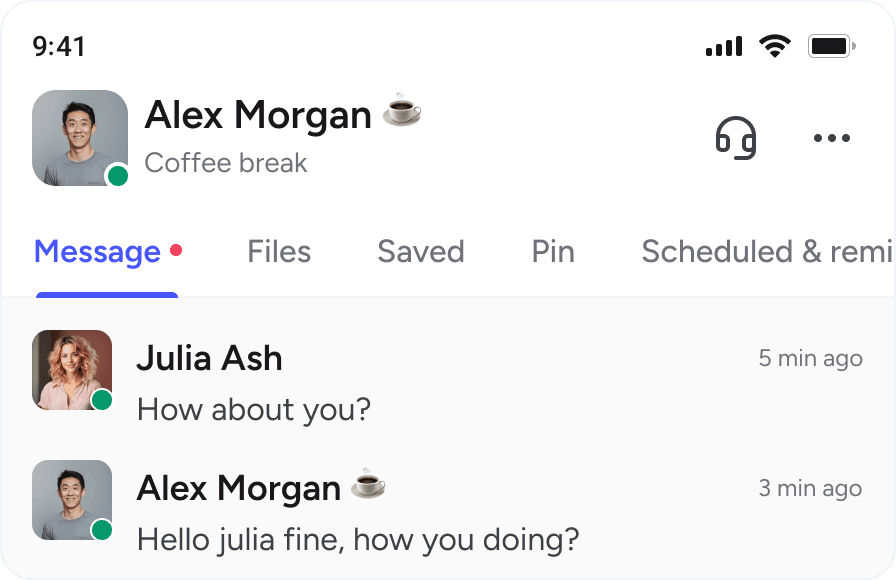
- Chat: channels, DMs, threads, group chats, meetings, scheduled messages, reminders, saved items and pins. Company announcements can go in a dedicated channel and stay pinned.
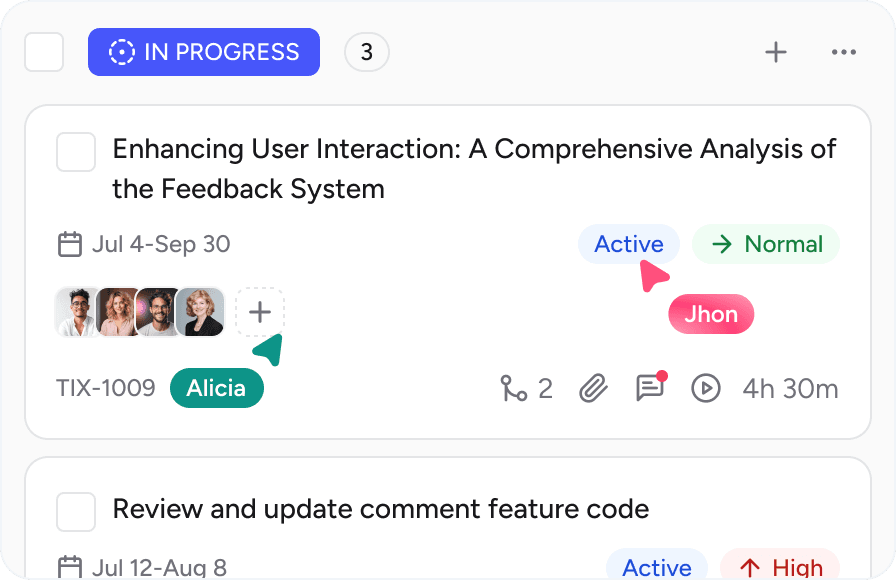
- Context next to the conversation: projects (kanban, roadmap, calendar, time tracking), a wiki, and HR in the same app. Your team can see who is on leave today, request and approve time off, and clock in or out on a live roster, without switching tools.
- Permissions: role-based access, guest users for clients and freelancers, member groups. SSO/SAML and audit logs on Enterprise.
- Mobile and desktop: iOS, Android, Mac and Windows apps.
- Price: see our pricing page. There is a 14-day free trial with no credit card, and the Starter plan has unlimited seats. Startups under 100 employees with funding can apply to our Startup Program.
- Watch out for: Tixio is not a corporate intranet with campaign analytics for a 20,000-person comms department. If that is you, look at Staffbase or Simpplr.
GetOnNet, a full-service digital agency in Norway, runs its projects, business development and operations in Tixio. If you want the side-by-side, here is our honest Tixio vs Slack comparison.
3. Google Chat
Best for: Google Workspace companies that want chat without another vendor.
Google Chat is included with Google Workspace plans, sitting next to Gmail, Drive and Meet. It is simple, decent at search, and costs nothing extra if you already pay for Workspace.
- Price: Chat is included in every Workspace plan. Google announced Business Standard at $14 per user per month in January 2025, including Gemini. Google's pricing page offers a 16% saving with a one-year commitment.
- Watch out for: it is the most basic chat tool on this list. Fine for conversation, light on announcements, and no help with projects or HR.
4. Staffbase
Best for: large enterprises with a dedicated internal comms team and a big frontline workforce.
Staffbase is a serious employee communication platform: branded apps, intranet, email newsletters, targeting and analytics. If you have a comms department sending campaigns to 10,000 people, this is the kind of tool they want.
- Price: not published. Staffbase's pricing page offers frontline, whole-workforce and enterprise quotes, and its FAQ says a published price "would be wrong for most organizations."
- Watch out for: it is a broadcast tool. Daily teamwork still needs a separate chat or project tool, and the setup effort is real.
5. Connecteam
Best for: small and mid-size frontline businesses: retail, field services, hospitality, cleaning, construction.
Connecteam is built phone first for deskless teams, with chat, updates, a knowledge base and surveys in its Communications hub, plus separate hubs for scheduling and time tracking.
- Price: the Communications hub Basic plan is $29 per month for the first 30 users billed yearly, plus $0.50 per extra user. There is a free Small Business plan for up to 10 users.
- Do the math: for 50 users on Basic, that is $29 plus 20 times $0.50, so $39 per month. Very cheap.
- Watch out for: it is designed for frontline operations. Office teams who need deep project management or heavy collaboration will want something else alongside it.
6. Workvivo
Best for: larger companies that care most about culture, recognition and engagement.
Workvivo (owned by Zoom) feels like a social network for your company: a feed, recognition, communities, events, plus employee listening through its Seer product.
- Price: not published. Workvivo's pricing page says pricing depends on licence count and needs. It lists add-ons including Chat and an AI agent, and says there is no free trial, only a demo.
- Watch out for: a culture platform is not a work platform. You will still run day-to-day collaboration somewhere else.
7. Simpplr
Best for: mid-size and large companies replacing an old intranet.
Simpplr is a modern intranet with AI-powered search, personalized news and employee experience features. It is strong on making company information findable.
- Price: not published. Simpplr's pricing page asks for a personalized quote, mentions volume discounts from 500 employees, and offers a 14-day free trial with limited spaces.
- Watch out for: it is a destination people visit, not where they chat all day. Pair it with a chat tool and you are back to two places to check.
8. Microsoft Teams
Best for: companies already paying for Microsoft 365.
If your company runs on Outlook, SharePoint and Office, Teams is the default for good reason. Chat, meetings, files and calling sit in one place.
- Price: Microsoft Teams Essentials is $4.00 per user per month with an annual subscription. Microsoft 365 Business Basic, which adds email and more, is $7.00 per user per month.
- Watch out for: Teams can feel heavy, and Microsoft's own data says its users get 153 Teams messages per weekday. That is a configuration and culture problem as much as a product one, but you will need to manage it.
Quick picks
- Already on Microsoft 365: Teams.
- Already on Google Workspace and want simple: Google Chat.
- Desk team that loves integrations: Slack.
- Frontline SMB on a budget: Connecteam.
- Enterprise comms department: Staffbase, Simpplr or Workvivo.
- SMB tired of switching between chat, projects and HR: Tixio.
A 30-day rollout plan your team will actually follow
Most internal communication tools do not fail at purchase. They fail in week two, when half the team quietly drifts back to WhatsApp. This plan is built around that.
Days 1 to 7: set up before you invite
- Pick one owner. Not a committee. One person who answers questions and makes calls.
- Write down the 3 to 5 problems you are solving. "People miss announcements" and "nobody knows who is on leave" are good. "Better collaboration" is not.
- Create a small, boring channel structure: one announcements channel, one channel per team, one per active project, and a social channel. Fewer is better.
- Write a one-page "how we communicate" guide: what goes in chat, what goes in a task, what goes in the wiki, and what is urgent enough for a DM.
- Set up permissions and groups before anyone joins, so nobody sees the wrong thing on day one.
Days 8 to 14: pilot with one real team
- Invite one team of 8 to 15 people, ideally one that complains a lot. They will find the problems fast.
- Move one real workflow in, such as a weekly update or leave requests. Not a test project.
- Ask them to install the mobile app on day one, and check it works on their actual phones.
- Collect friction daily. Fix settings, notifications and channel names as you go.
Days 15 to 21: roll out to everyone
- Leadership posts first, in the new tool, and only in the new tool. If the CEO still sends announcements by email, everyone will keep checking email.
- Run a 20-minute walkthrough per team, focused on their daily work, not every feature.
- Pin the "how we communicate" guide where everyone can see it.
- Set notification defaults that protect focus: mute busy channels, keep announcements loud, schedule messages for working hours.
Days 22 to 30: measure and switch off the old tools
- Check weekly active users and how many people opened the announcements channel.
- Ask one question in a pulse survey: "Is it easier to find information than a month ago?"
- Set a hard date to retire the old tool, and archive it so history is still searchable.
- Write down what you learned. You will need it when you onboard the next hire, and our remote onboarding checklist can help.
Mistakes to avoid when rolling out internal communication tools
We have seen every one of these, sometimes in our own company.
- Buying for the demo, not for week six. Demos show the happy path. Score tools on search, permissions and mobile with your own messy data.
- Letting channels multiply. Fifty channels for a 30-person team is not communication, it is a maze. Archive anything quiet for 30 days.
- Treating announcements like chat. If it matters, pin it, put it in a dedicated channel, and keep that channel for announcements only.
- Forgetting frontline staff. If a third of your team does not have a laptop, and your new tool only shines on desktop, you have built a two-tier company.
- Keeping the old tool "just in case." Two systems means everyone checks both, or nobody checks either. Pick a switch-off date.
- Ignoring after-hours messages. Microsoft found the average employee sends or receives more than 50 messages outside core hours. Use scheduled messages and set clear norms about response times.
- Putting knowledge in chat. Chat is for conversation. Decisions, policies and how-tos belong in a wiki or company docs, as we argue in our piece on why every team needs company docs.
- Measuring installs instead of use. "Everyone has the app" means nothing. Weekly active users, announcement reads and fewer repeated questions mean something.
Go deeper on internal comms
- Internal communication strategy and a fill-in-the-blanks plan template
- Internal newsletter: 45 ideas and a template people actually read
Where to start this week
You do not need a six-month project to fix internal communication. You need a clear job for the tool, a scorecard, two contenders, and 30 days of honest testing with real work.
Start with the framework above. Score your current setup first: you may find the problem is five tools, not the wrong tool.
If your team keeps bouncing between chat, project boards and HR spreadsheets, try putting them in one place. Start a 14-day free trial of Tixio, no credit card needed, and check if your team opens it on day 15 without being asked. That is the only test that really counts.