-1.png)
The best competitive intelligence tools in 2026 are Semrush and Ahrefs for what competitors do in search, Similarweb for traffic and audience, Crayon and Klue for automated change tracking, Owler and Crunchbase for company and funding signals, G2 and Capterra reviews for what customers actually complain about, and Tixio for the part every tool ignores: keeping the findings somewhere your team will read them.
That last point is not a throwaway. Most competitive intelligence programmes fail at storage and distribution rather than collection. The data was gathered, put in a deck, presented once, and never opened again.
The five things competitive intelligence actually answers
Buy tools against questions, not categories. These are the questions that change decisions.
- What are they charging, and did it change? Pricing page changes are the highest signal, lowest effort thing to monitor, and most companies do not watch them
- What are they shipping? Changelogs, release notes and job postings tell you the roadmap months before the announcement does
- Where is their traffic coming from? Whether they are winning on search, paid, partnerships or community determines whether you can copy it
- What do their customers complain about? Review sites are the cheapest source of genuine product intelligence in existence and are consistently underused
- Who is hiring for what? Job postings are the most honest public statement a company makes about its plans
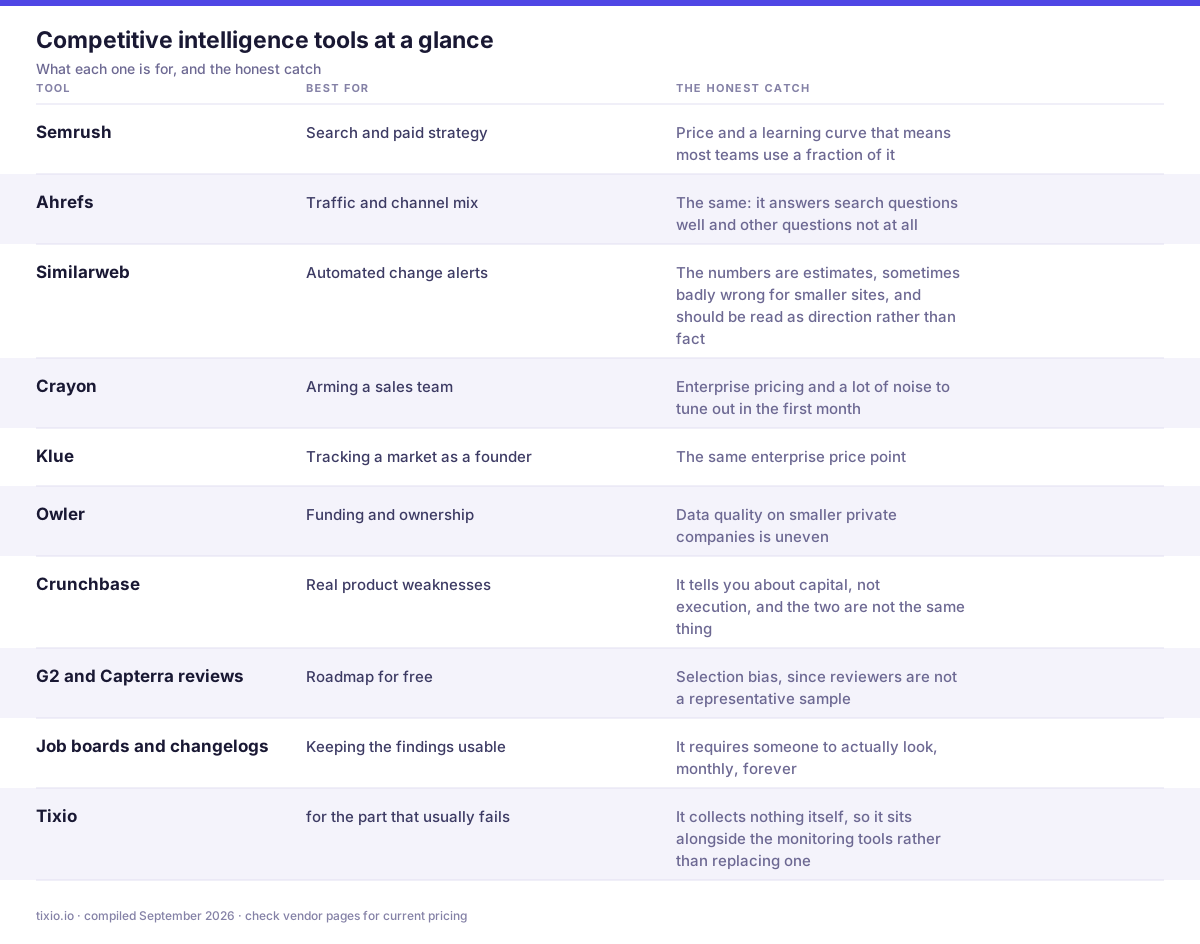
The whole list in one view. The right hand column is the part most comparison posts leave out.
10 competitive intelligence tools
1. Semrush, for search and paid strategy
The deepest view of what competitors rank for, what they bid on, and which pages drive their organic traffic. Strong for content gap analysis, which is the most actionable output in the whole category. The catch is price and a learning curve that means most teams use a fraction of it.
- What it does well: the widest view of a competitor's search strategy. Organic keywords, paid ads, ad copy history, content gaps and share of voice in one account.
- Where it bites: the tier names changed in 2026 and the entry price moved with them. Extra seats and several toolkits, Local, Social and .Trends, are paid add-ons on top.
- Best for: teams whose competitive question is where does their traffic actually come from.
Pricing: free plan with 1 project and 10 reports a day. SEO $117.33 a month billed annually ($139 monthly), Starter $165.17 annually ($199 monthly), Pro+ $248.17 annually, Advanced $455.67 annually. Semrush and pricing
2. Ahrefs, the alternative view of the same question
Comparable to Semrush with stronger backlink data and a cleaner interface. Which of the two you prefer is largely habit. The catch is the same: it answers search questions well and other questions not at all.
- What it does well: the better backlink index and a cleaner interface for the same questions. Site Explorer gives you a competitor's link acquisition pattern faster than anything else.
- Where it bites: no meaningful free tier beyond Webmaster Tools on your own verified sites, and uncapped API plus SSO only exist on the $1,499 Enterprise plan.
- Best for: anyone whose competitive analysis is mostly a link and content question.
Pricing: Webmaster Tools is free for sites you own. Starter $29 a month, Lite $129, Standard $249, Advanced $449, Enterprise $1,499 with an annual commitment, all saving about 17% annually. Ahrefs and pricing
3. Similarweb, for traffic and audience
Estimates of traffic volume, channel mix and audience overlap across the whole web, not just search. Useful for understanding whether a competitor's growth is real. The catch is that the numbers are estimates, sometimes badly wrong for smaller sites, and should be read as direction rather than fact.
- What it does well: the only credible estimate of total traffic, channel mix and audience overlap, which is the number every board deck wants and no other tool gives.
- Where it bites: the numbers are estimates and get shaky below roughly 50,000 visits a month, and most real buying happens through sales at undisclosed annual contract values.
- Best for: market sizing and board level competitive context, not day to day tactics.
Pricing: free checker with 5 results per metric and 1 month of history. Self service Web Intelligence from $125 a month billed annually ($199 monthly), with higher tiers around $333 and $542 a month annually. Business, Enterprise and API are quote only. Similarweb and pricing
4. Crayon, for automated change tracking
Monitors competitor websites, pricing pages, messaging and content, and tells you what changed. This is the category that saves the most manual work. The catch is enterprise pricing and a lot of noise to tune out in the first month.
- What it does well: watches competitor sites, pricing pages, messaging and job posts automatically, and tells you what changed rather than making you look.
- Where it bites: no public pricing at all, no free tier, and the value depends entirely on someone reading and acting on the alerts.
- Best for: companies with a named competitive intelligence owner and a real budget.
Pricing: quote only. Crayon publishes no tiers and routes every pricing question through a demo or estimate request, so treat any number you find elsewhere as guesswork. Crayon and pricing
5. Klue, for sales enablement
Similar monitoring to Crayon, oriented around getting battlecards into the hands of sales reps at the moment they need them. The right pick when the consumer of the intelligence is a sales team rather than a product team. The catch is the same enterprise price point.
- What it does well: turns the same monitoring into battlecards reps open in the CRM at the moment a competitor comes up in a deal.
- Where it bites: also entirely quote only, and it is priced for organisations with a sales enablement function rather than a founder doing this on a Friday.
- Best for: sales teams losing deals to two or three named competitors repeatedly.
Pricing: quote only, with no tiers published anywhere on the site. Expect an annual enterprise contract negotiated on seats or consumers of the content. Klue and pricing
6. Owler, for company level signals
Funding, headcount, leadership changes and news alerts across a watchlist of companies. Cheap or free at the entry level and genuinely useful for founders tracking a market. The catch is that data quality on smaller private companies is uneven.
- What it does well: cheap company level alerting. Funding, headcount, leadership changes and news on the companies you follow, delivered without you searching.
- Where it bites: the free tier follows only 5 companies, and CRM integrations plus API access require the quote only Enterprise tier.
- Best for: small teams who want signals rather than a programme.
Pricing: Community free for up to 5 companies. Owler Pro is reported at $39 per user per month billed annually, about $468 a year, with Max, Enterprise and API quote only. Confirm on the page as it renders client side. Owler and pricing
7. Crunchbase, for funding and ownership
The reference source for who raised what, from whom, and when. Essential context for understanding whether a competitor is about to accelerate. The catch is that it tells you about capital, not execution, and the two are not the same thing.
- What it does well: the reference source for funding, investors, ownership and acquisition history, which tells you how much runway a competitor has and who they answer to.
- Where it bites: exports and alerts need a paid plan, monthly billing roughly doubles the cost, and CRM sync plus API only start at Business.
- Best for: understanding whether a competitor is about to get aggressive or about to get bought.
Pricing: free account with limited search and no exports. Pro $49 per user per month billed annually ($99 monthly), Business around $199 per user per month annually, Enterprise on request. Crunchbase and pricing
8. G2 and Capterra reviews, for product truth
The most underrated source on this list. Filter a competitor's reviews to one and two stars and read every one. You will learn more about their real weaknesses in an hour than from any dashboard. The catch is selection bias, since reviewers are not a representative sample.
- What it does well: the cheapest honest intelligence available. Filter a competitor's reviews to one and two stars and you have their churn reasons in the customer's own words.
- Where it bites: reviews are gamed, incentivised and skewed towards recent campaigns, so read patterns rather than individual posts.
- Best for: finding the objection your sales team keeps losing to.
Pricing: reading reviews is free on both. G2 and Capterra. Paid vendor profiles and buyer intent data are sold separately and priced on request.
9. Job boards and changelogs, for free roadmap intelligence
Not a tool, a habit. A competitor hiring three infrastructure engineers and a compliance lead is telling you their next twelve months. Their changelog is telling you the last three. Both are free and public. The catch is that it requires someone to actually look, monthly, forever.
- What it does well: free, public and unusually honest. Job posts reveal the next twelve months of roadmap, changelogs reveal the last three, and neither is written by marketing.
- Where it bites: it is manual, so it only works if someone owns the habit and writes down what they saw.
- Best for: founders and small teams with no budget and good judgement.
Pricing: free. Track competitor careers pages, LinkedIn Jobs, their public changelog and release notes, and set a Google Alert for the company name.
10. Tixio, for the part that usually fails
Every tool above produces findings. Almost none of them solve where the findings live afterwards. The usual result is a competitor deck one person maintains, a folder of screenshots, and links scattered across private bookmarks, which means the intelligence exists and nobody can find it. Tixio keeps competitor links, notes, docs and the conversation about them in one searchable workspace with permissions, so a finding from March is still findable in September. The catch is that it collects nothing itself, so it sits alongside the monitoring tools rather than replacing one.
- What it does well: holds the findings. Shared collections of competitor pages, docs and notes with chat and tasks beside them, so intelligence turns into a decision rather than a screenshot in someone's downloads folder.
- Where it bites: it does not gather anything. No monitoring, no alerts, no traffic estimates. It is the layer under the tools above, not a replacement for them.
- Best for: teams who keep doing the research and keep losing it.
Pricing: 14 day trial, no card. Starter $2.80 per user per month billed annually ($4 monthly), Team $6.30 annually ($9 monthly), Enterprise on request. Tixio pricing
Choosing in one line each
- Search and paid strategy: Semrush or Ahrefs
- Traffic and channel mix: Similarweb
- Automated change alerts: Crayon
- Arming a sales team: Klue
- Tracking a market as a founder: Owler
- Funding and ownership: Crunchbase
- Real product weaknesses: G2 and Capterra reviews
- Roadmap for free: job boards and changelogs
- Keeping the findings usable: Tixio
A competitive intelligence routine that costs two hours a month
Most companies do not need an enterprise platform. They need a routine that somebody actually runs.
- Pick five competitors. Not fifteen. Three direct, two adjacent
- Screenshot every pricing page on the first of the month. Ten minutes, and it produces a change history no tool gives you for free
- Read their changelog and their careers page. Twenty minutes, and it is the highest signal per minute on this list
- Read ten recent one and two star reviews for each. Forty minutes, and it is where product decisions actually come from
- Write five bullet points on what changed and what it means. Not a deck. Five bullets, dated, in a place the team can search
- Link the evidence rather than pasting screenshots into a document, so the source is still reachable later
That routine beats an unused enterprise subscription by a wide margin, and it survives someone going on holiday.
The mistake that wastes the whole programme
Collecting far more than anyone reads. Competitive intelligence has the same failure mode as every other kind of research: capture is easy and retrieval is what creates value. If your competitor file is a folder of links nobody has opened since it was made, you have built a silo, not an advantage.
Two rules fix it. Write the implication, not just the fact, because nobody acts on a fact without an interpretation. And put it where people already work rather than in a dedicated tool they will visit once a quarter. The same principles that make a resource library work apply exactly here.
Related reading
Related reading: 11 best content curation tools, how to build a resource library, and best work management software.
The short version
Watch pricing pages, changelogs, job postings and one star reviews. That is most of the value, and all of it is free. Buy a monitoring platform only once someone is reliably running the manual routine, and write the implication rather than the fact, because a finding nobody interprets is a finding nobody uses.