
Tixio Journal

Tixio vs Trello in 2026 | When Your Team Outgrows a Kanban Board

Trello is simple, visual, and easy to start. But it does not scale with your team. Tixio gives growing teams the kanban simplicity they love plus wiki, chat, CRM, HR, and more in one modular Work OS. Starting at $2.80/person.

U
Written byUmana
PublishedJune 5, 2026
Tixio vs Trello in 2026 | When Your Team Outgrows a Kanban Board

Trello is where a lot of teams start their project management journey, and for good reason. It is visual, intuitive, and requires almost no onboarding. But there comes a point in every growing team's life where a board of cards is no longer enough. Here is the honest comparison of Tixio and Trello in 2026.

Why You Are Comparing These Two

Trello was probably your team's first project management tool. It made sense immediately. Cards, columns, drag and drop. You set it up in an afternoon and your team was using it by the next morning. For a while, it was exactly what you needed.

Then things got more complex. You needed more than a board. You needed a place to document processes. You needed to track client relationships. You needed your HR to stop living in a spreadsheet. You needed to connect the conversation about a task to the task itself rather than chasing it through a Slack thread.

That is the moment teams start comparing Tixio and Trello. Not because Trello stopped working, but because the team grew past what a kanban board can handle.

What Trello Actually Does

Trello is a visual project management tool built around boards, lists, and cards. It is genuinely one of the simplest and most intuitive tools in its category. You can understand how to use Trello in about ten minutes, and that ease of adoption is a real competitive advantage.

Trello has added views over the years. Timeline, calendar, table, and dashboard views are available on paid plans. Power-Ups extend functionality through integrations. Butler automation handles basic workflow triggers.

But Trello's core is still a kanban board, and its limitations reflect that. There is no wiki. There is no team chat. There is no CRM. There is no HR module. There is no whiteboard. Advanced project features like sprint management, roadmaps, and cross-project visibility require Power-Ups that add complexity and cost without fully solving the underlying limitation.

Trello is owned by Atlassian, the same company behind Jira and Confluence. It is positioned as the simple entry point in a product ecosystem that upsells toward those more complex tools as teams grow. The path Atlassian wants you on is Trello today, Jira and Confluence tomorrow. Tixio is a different answer to that progression.

What Tixio Actually Does

Tixio is a modular Work OS that covers the full operational surface of a growing team. The Projects module includes kanban views that feel as intuitive as Trello, plus sprint, roadmap, list, and calendar views for when simple boards are not enough. And because Projects is one module in a connected workspace, every card connects to the wiki, the CRM, the chat thread, and the HR record that belongs to it.

The jump from Trello to Tixio is not a jump from simple to complex. It is a jump from one tool that does one thing to one workspace that does everything, at a price that makes the decision easy.

Feature by Feature: The Real Comparison

Kanban and Project Management

Trello's kanban experience is genuinely excellent for what it is. The drag-and-drop interface is smooth, the card detail view is clean, and the visual simplicity of a board makes project status immediately obvious to everyone. For simple workflows with clear stages, Trello is hard to beat on ease of use.

The limitations appear quickly for growing teams. No native sprint management. No roadmap view without a Power-Up. No cross-board visibility for teams running multiple projects simultaneously. No way to see a team member's workload across all their cards without building a complicated filter. Custom fields require a Business Class plan. Automation requires Butler configuration that is powerful but not intuitive.

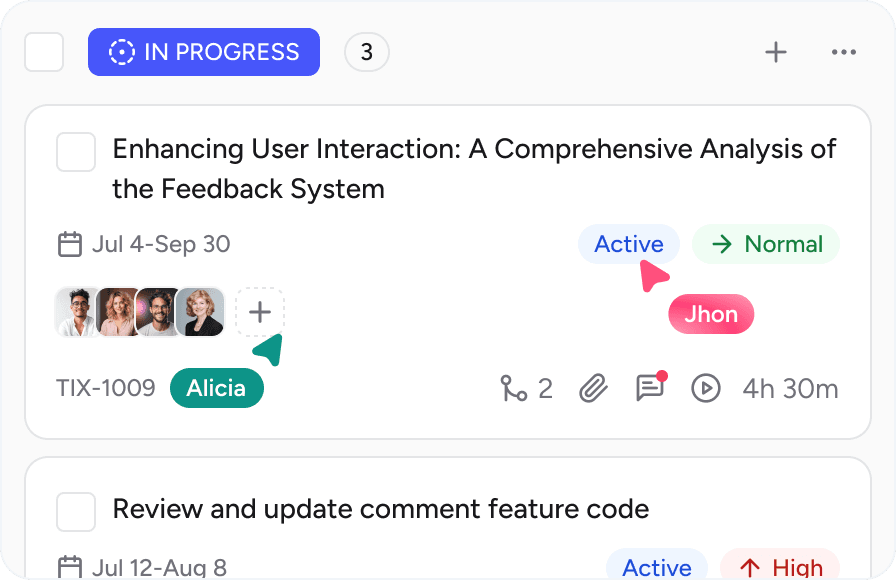
Tixio's Projects module starts from the same visual simplicity as Trello and builds up from there. Kanban boards work exactly as you would expect. Switching to a sprint view, a roadmap, or a calendar view is a single click. Cross-project visibility is built into the workspace dashboard. Workload management shows you what every team member is working on without a filter configuration session.

Winner for pure kanban simplicity with no learning curve: Trello. Winner for teams that need kanban plus everything else: Tixio.

Documentation and Wiki

Trello has no wiki. Cards can have descriptions and attachments. Teams build documentation workarounds using card descriptions, checklists, and attached Google Docs. It works for simple use cases and breaks down as soon as the documentation needs structure, search, or maintenance.

Most Trello teams run Notion or Confluence alongside it for documentation. That is a second subscription, a second login, and the structural gap between the work living in Trello and the documentation living elsewhere.

Tixio's Wiki is a full knowledge management system built into the same workspace as Projects. SOPs, onboarding guides, client briefs, company policies, and process documentation all live next to the tasks executing on them. When a team member opens a task, the relevant wiki page is one click away.

Winner: Tixio.

Team Communication

Trello has no team chat. Trello teams run Slack, Teams, or another communication tool alongside it. Card comments serve as a basic thread for task-specific discussion, but they are not a communication system.

Tixio's Chat module covers channels, direct messages, threads, file sharing, and voice notes inside the same workspace. Conversations about a task happen in context, linked to the task. Decisions become actions without a tool switch.

Winner: Tixio.

CRM

Trello has no CRM. Some teams build client tracking boards in Trello using cards as deals and lists as pipeline stages. It is a workaround that works until you need activity logging, contact records, relationship history, or any of the features that make a CRM useful for managing real client relationships.

Tixio's CRM module is a dedicated relationship management system connected to the rest of the workspace.

Winner: Tixio.

HR and People Operations

Trello has no HR module. Tixio's HR module handles attendance, leave management, contracts, and onboarding workflows natively. For any team managing more than a handful of people, this is a significant advantage.

Winner: Tixio.

Pricing: The Honest Comparison

Trello's pricing in 2026 sits at $5 per user per month for the Standard plan and $10 per user per month for the Premium plan. The free plan is genuinely useful for very small teams with simple needs, but the limitations on Power-Ups, views, and automation push most growing teams to a paid plan.

For a 15-person team on Trello Premium, that is $150 per month for a kanban tool. That same team still needs Notion or Confluence for documentation, Slack for communication, a CRM, and an HR tool. Total stack cost lands between $350 and $500 per month minimum.

Tixio at $2.80 per person per month costs $42 per month for the same 15-person team with every module included.

Where Trello Wins

Trello is the right choice for very small teams with simple, visual project tracking needs and no requirement for documentation, communication, CRM, or HR management. If your entire operation fits on a few kanban boards and you have separate tools for everything else that you are happy paying for, Trello does what it does very well.

It is also a strong choice for freelancers, solo operators, and personal project tracking where the simplicity and the free plan's generous limits are genuinely useful.

Where Tixio Wins

Tixio wins the moment a team needs more than a kanban board. For teams that have outgrown Trello's simplicity, that are running multiple tools alongside it, or that want one workspace covering their full operational day without paying for and maintaining separate tools for documentation, communication, and people management, Tixio is the natural next step.

It retains the visual simplicity that makes kanban boards work while adding every layer of functionality that growing teams need. And at $2.80 per person per month, the cost of making the switch is not the barrier.

FAQs

Is Tixio a good alternative to Trello? Yes, especially for teams that have outgrown simple kanban boards. Tixio includes kanban project management alongside wiki, team chat, CRM, HR, and canvas in one workspace at a price comparable to Trello alone.

Does Trello have a wiki or documentation feature? No. Most Trello teams run Notion or Confluence alongside it for documentation. Tixio's Wiki is built into the same workspace as projects and chat, with no additional subscription required.

Does Trello have team chat? No. Trello teams typically run Slack alongside it. Tixio's Chat module replaces that need entirely.

Which is cheaper, Tixio or Trello? Trello Premium costs $10 per user per month for project management alone. Tixio starts at $2.80 per person per month with all modules included, replacing Trello and the additional tools most teams run alongside it.

Who is Trello best suited for? Trello is best suited for very small teams, freelancers, and solo operators with simple visual project tracking needs. For growing teams that need documentation, communication, CRM, and HR alongside project management, Tixio covers all of it in one workspace.


Tixio vs Slack in 2026: Your Team Deserves More Than a Chat App

Meta title: Tixio vs Slack in 2026 | Why a Chat App Is Not a Work OS

Meta description: Slack is where conversations happen. But work does not live in conversations. Tixio gives teams one workspace where chat, projects, wiki, CRM, and HR are all connected. See how Tixio compares to Slack in 2026.

Excerpt: Slack changed how teams communicate. It made real-time messaging the default, killed most internal email, and became the place where everything important happened in conversation. The problem is that conversation is not the same as work. And in 2026, the teams paying $7 to $12 per person per month for a chat app are asking whether that money could do more. Here is the honest answer.

Start free

Let your plans shape the future.

Start your free trial today. No credit cardrequired.

14 day trial. Cancel anytime.

Trusted by expertsacross 30+ countries
Backoffice
Getonnet

Get started with Tixio

Let us help build your team OS & workflows. See it in action on live workspace
Tixio workflow preview left
Tixio workflow preview center
Tixio workflow preview right